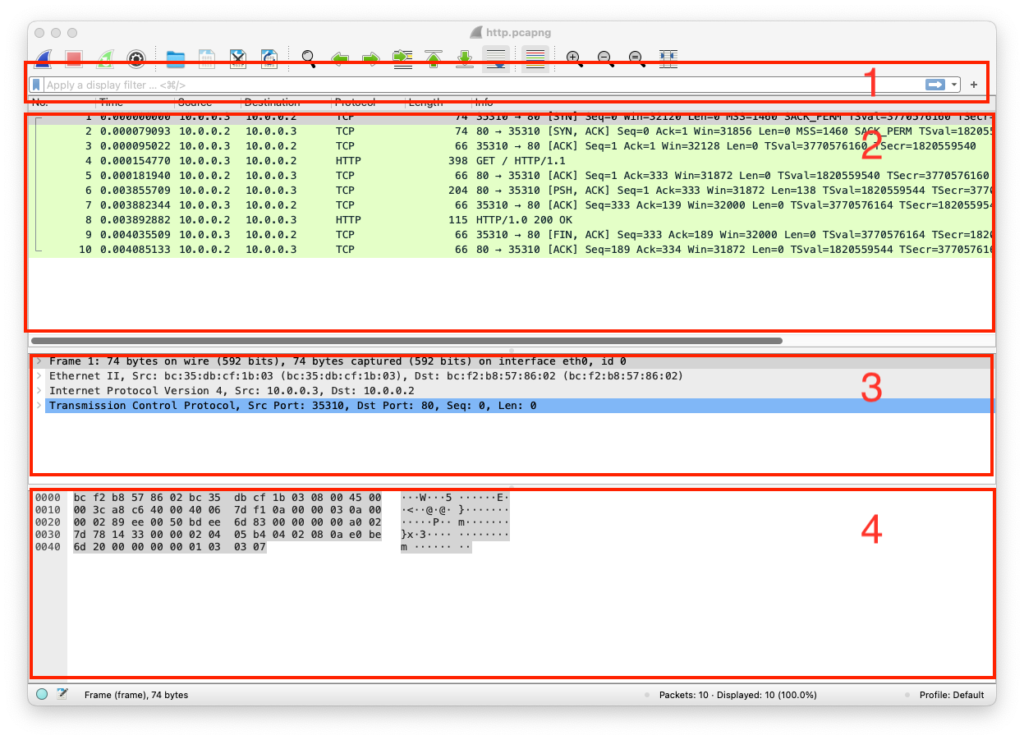
Tag: Wireshark

  • Application Layer

    Application Layer

    Application Layer

    The Application Layer is the seventh and topmost layer of the OSI model, providing the interface for end users to interact with network services. It acts as a bridge between user applications and the underlying network, allowing software to access communication functions without managing data transport or routing. This layer handles high-level protocols and services that enable tasks such as sending emails, browsing the web, transferring files, and accessing remote databases.

    By providing these services, the Application Layer ensures seamless and efficient user interaction with the network.

    In addition to user interaction, the Application Layer formats, presents, and interprets data in a way applications can understand. It could include functions such as data encoding, encryption, and session management to ensure information is meaningful, secure, and correctly synchronized. For example, a web browser at this layer requests HTML pages from a web server via HTTP and presents the content to the user in a readable format. Similarly, email clients use protocols such as SMTP, POP3, and IMAP to send, receive, and organize messages.

    The Application Layer interacts closely with the Presentation and Session Layers to provide complete end-to-end services. While the Presentation Layer handles data translation and formatting, and the Session Layer manages communication sessions, the Application Layer focuses on making network services accessible and usable to end users. This layer encompasses a wide variety of protocols and services, from web and email to file transfer, remote login, and messaging, ensuring that network functionality translates into practical, user-facing applications.


    Hypertext Transfer Protocol (HTTP)

    Hypertext Transfer Protocol (HTTP) is a TCP/IP-based protocol that enables communication between a client, such as a web browser, and a web server. It defines the rules for requesting and delivering resources like HTML pages, images, videos, and other web content over the internet

    HTTP operates as a stateless protocol, meaning each request from a client to a server is independent. However, extensions like cookies and sessions can maintain state across multiple interactions. By standardizing communication between clients and servers, HTTP enables users to access and navigate websites seamlessly, making it the foundation of data exchange on the World Wide Web.

    Some HTTP Headers

    • Host: Target virtual host to use (HOST:PORT)
    • Server: Target server that handled the request
    • User-Agent: Software/Browser that is making the request

    Some HTTP request methods

    • GET: Read data
    • POST: Insert data
    • HEAD: Return metadata about the target

    Some HTTP Response Status Codes

    • 200: Request has succeeded
    • 404: Server cannot find the requested resource
    • 500: Internal server error

    If you want to get a file named test.html from qeeqbox.com, your HTTP request will be something like this

    GET /test.html HTTP/1.1
    Host: www.qeeqboox.com

    If the server does have the requested file, the HTTP response will be

    HTTP/1.1 200 OK
    Content-Length: 12
    Content-Type: text/plain; charset=utf-8

    Hello World!

    If the file does not exist, the HTTP response will be

    HTTP/1.1 404
    Content-Length: 0

    Uniform Resource Locator (URL)

    A Uniform Resource Locator (URL) is a standardized and unique identifier used to locate and access resources on the internet, such as web pages, files, or services. It provides the necessary information for a client, like a web browser, to retrieve a resource from a specific server.

    • Protocol: A set of rules that define how content is transferred between the web server and browser
    • Sub Domain: An extension to a domain name to separate a website section
    • Root Domain: A website’s main or primary domain
    • Top Level Domain: An identifier that’s used to categorize the domain
    • Sub Directory: A directory that exists inside another directory
    • Path: A location on the website
                    Top Level Domain
                          |
          Sub-Domain      |           Path
             |            |            |
            ---          ---      --------------
    https://www.qeeqboox.com:433/files/test.html
    -----       --------     |   ----- ---------
       |           |         |    |       |
    Protocol       |        Port  |      File
               Root Domain        |
                             Sub Directory

    Process

    A process is an instance of a running application on a computer or device. It represents the program in action, including its code, current activities, memory allocation, and system resources it uses while executing. A single application can create multiple processes simultaneously, allowing different parts of the program to run independently or enabling multiple users to use the same application at once.

    The operating system manages processes by allocating resources, scheduling execution, and isolating each process to prevent interference. This ensures that applications run efficiently and securely.

    • Foreground: Requires user to interact with it
    • Background: Does not require users to interact with it

    Services

    A service is a type of process that runs continuously in the background without terminating, providing ongoing functionality to the operating system or other applications. Unlike regular processes that start and stop with user interaction, services are designed to operate independently. They typically start automatically when the system boots and run until it shuts down.

    Examples include web server services, database services, and print spoolers. These services handle requests, manage resources, or deliver functionality continuously. By operating persistently, services ensure that essential system functions and networked applications remain available and responsive at all times.


    Application

    An application is a software program designed to perform specific tasks or functions for users or other systems. It provides a user-friendly interface or automated processes that allow individuals or devices to accomplish objectives such as word processing, web browsing, data analysis, gaming, or communication.

    Applications can range from simple utilities to complex software suites and rely on underlying system resources, such as the operating system and network services, to function effectively. By translating user inputs into actions and delivering outputs in a usable form, applications bridge the gap between technical systems and practical, everyday tasks.


    Web Application

    A web application is a software program that runs on a web server and is accessed by users through a web browser or network client over the internet or an internal network. Unlike traditional desktop applications, web applications do not require local installation and can provide interactive functionality such as online shopping, email services, social media platforms, or cloud-based productivity tools.

    Web applications rely on web technologies like HTML, CSS, JavaScript, and server-side programming languages to process user input, communicate with databases, and deliver dynamic content. By operating over a network, web applications allow users to access services from anywhere, on various devices, while centralizing maintenance and updates on the server side.


    Cyberattacks

    • Cross-Site Scripting
      • A threat actor aims to execute malicious actions on the victim’s website (It’s a client-side code injection attack)
        • Reflected Cross-Site Scripting
          • A threat actor injects malicious content into web pages or web applications. The content will be reflected in the response and executed in the victim’s browser
        • Dom-Based Cross-Site Scripting
          • A threat actor injects malicious content into web pages or web applications. The content is not reflected in the response and is executed in the victim’s browser
        • Stored Cross-Site Scripting
          • A threat actor injects malicious content into a vulnerable server. The content is retrieved by users and then execute
    • Cross-site request forgery
      • A threat actor may trick an authenticated or trusted victim into transmitting unauthorized actions on their behalf
      • A threat actor crafts an exploit URL for a fund transfer and sends it to an authenticated user
    • Denial-of-service (DoS)
      • A threat actor makes a target device\resource unavailable by overloading it using a device
      • A threat actor uses one device to overload XYZ LLC’s website (This was common in the old days, but nowadays it often does not work )
    • Distributed Denial of Service (DDoS)
      • A threat actor makes a target device\resource unavailable by flooding using multiple devices
      • A threat actor uses hundreds of infected devices to flood XYZ LLC’s website

    PCAP Example

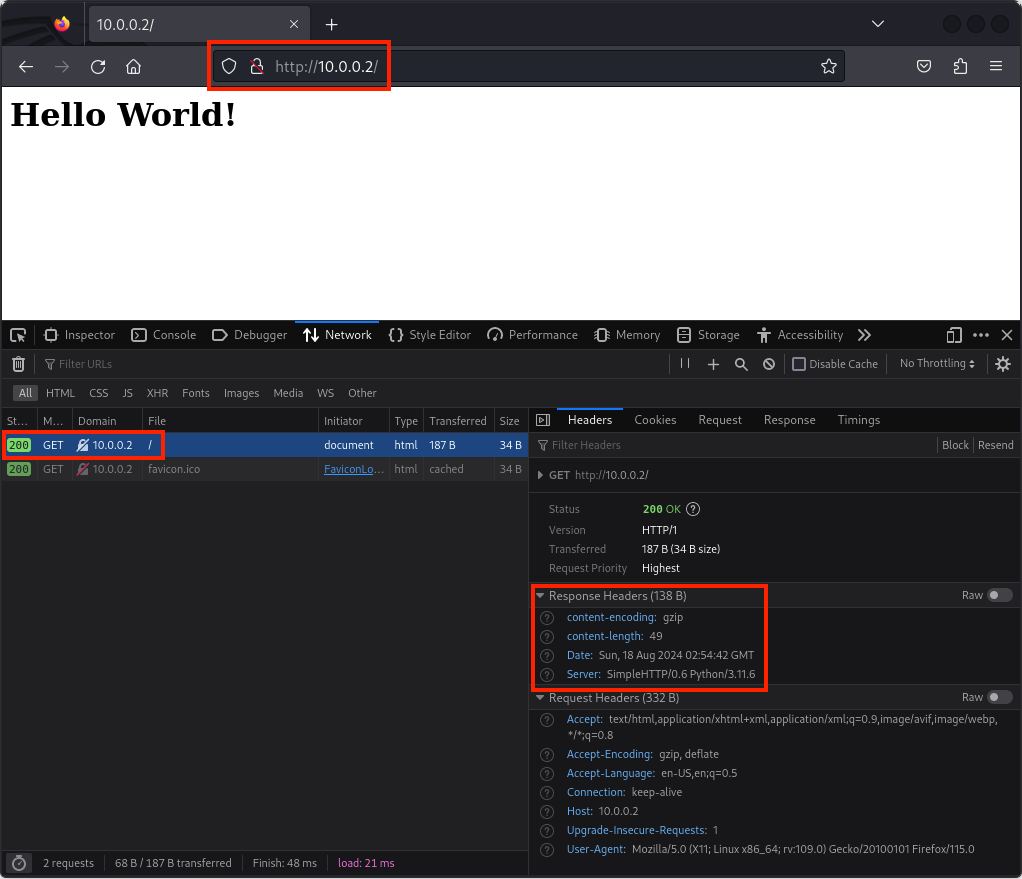
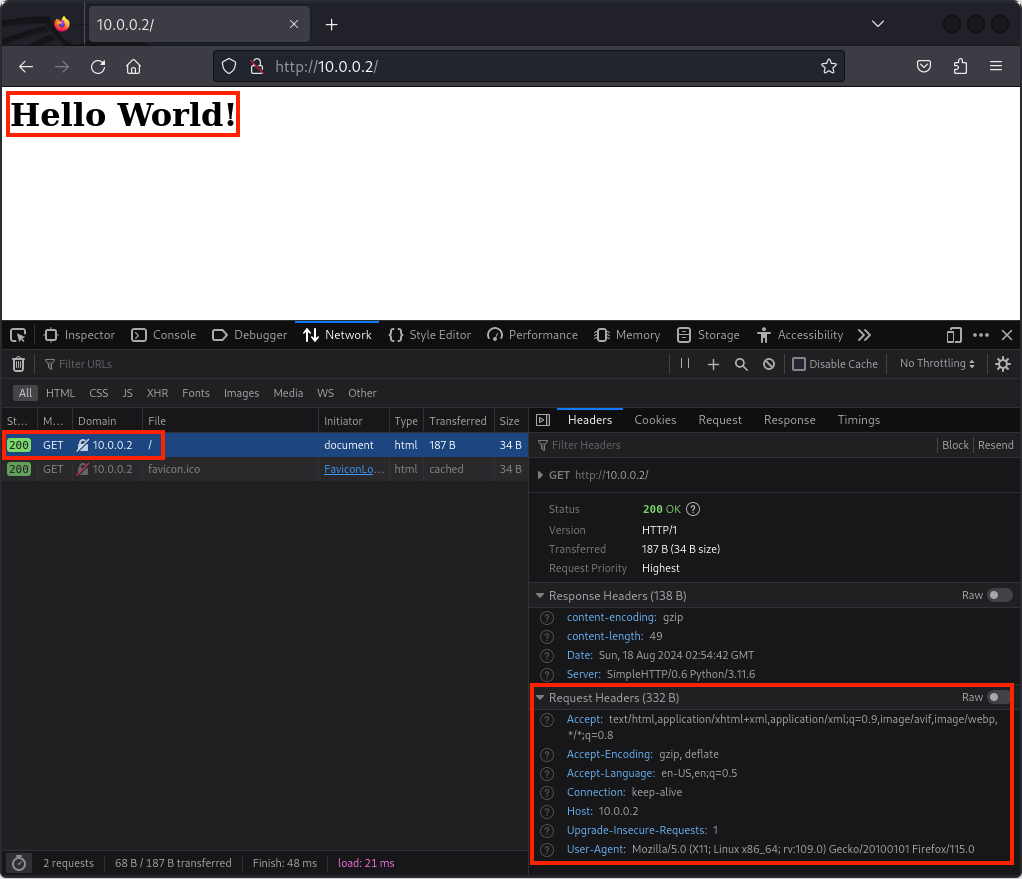
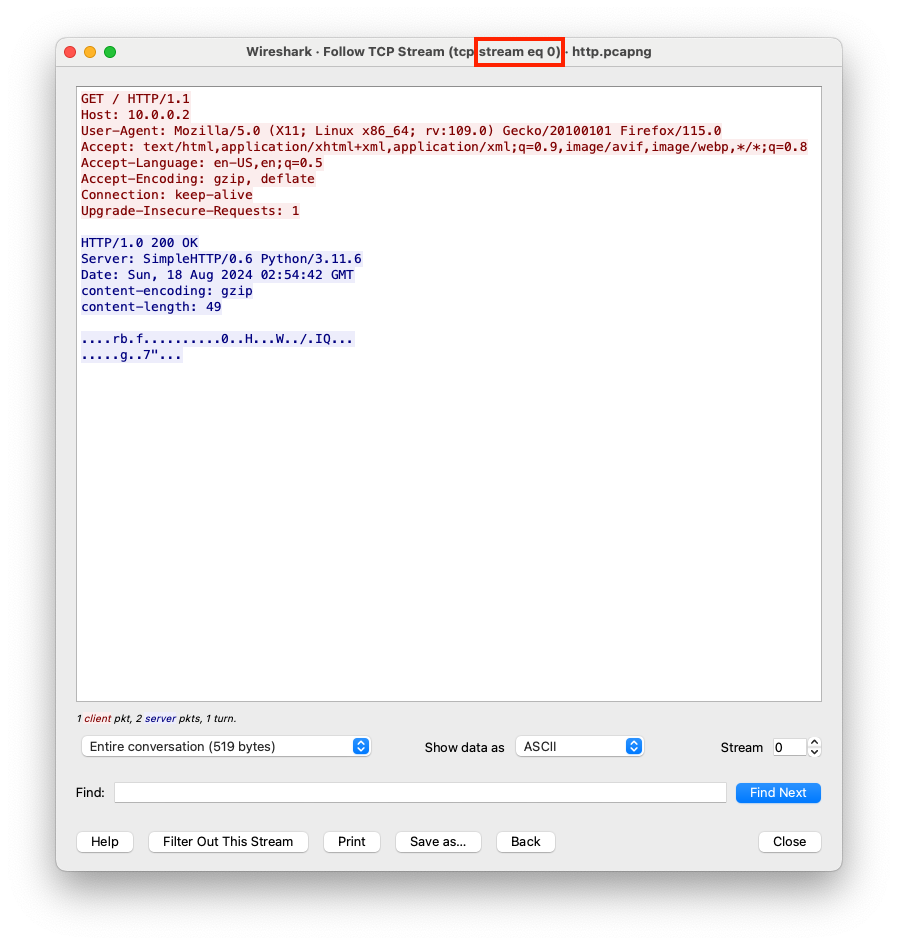
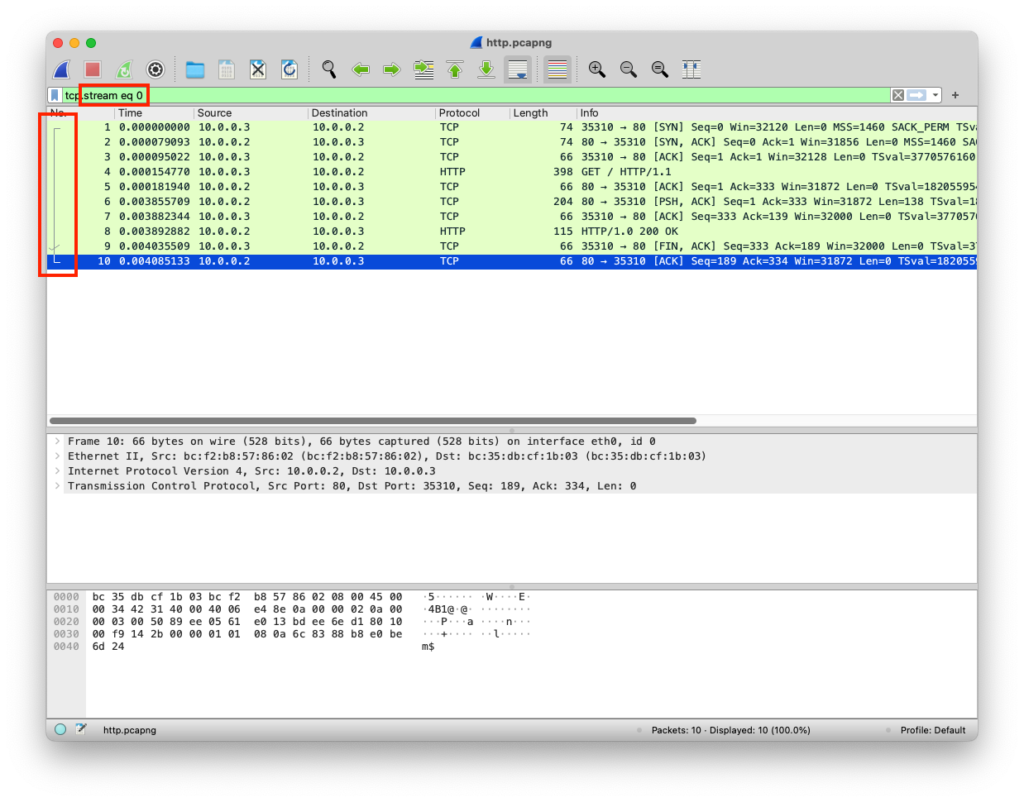
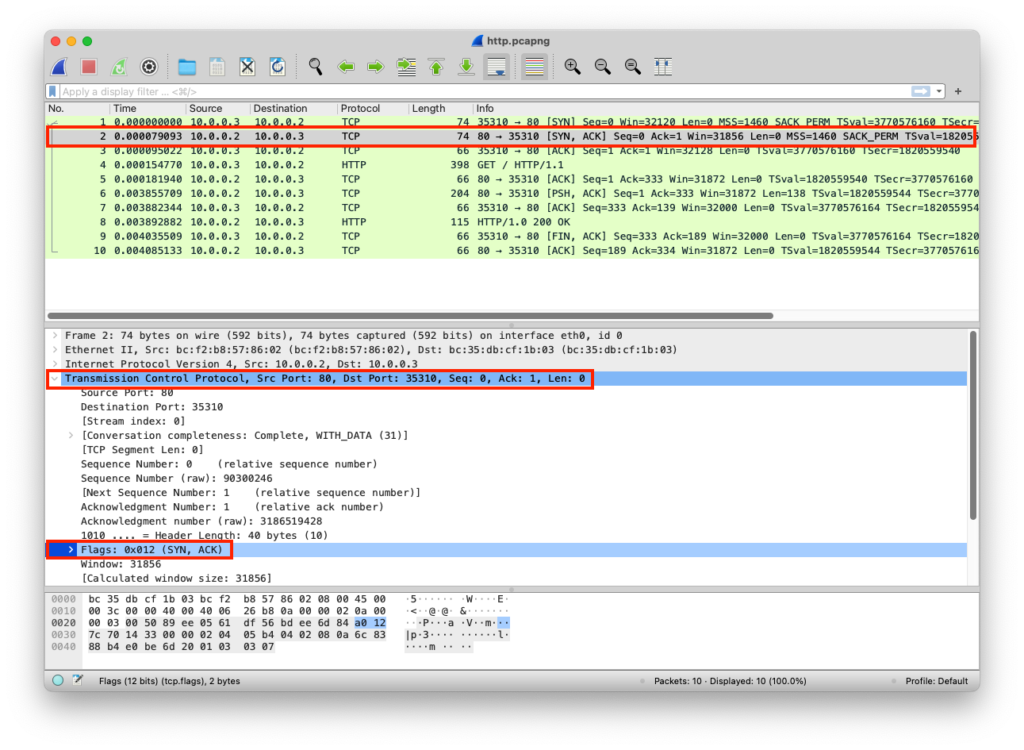
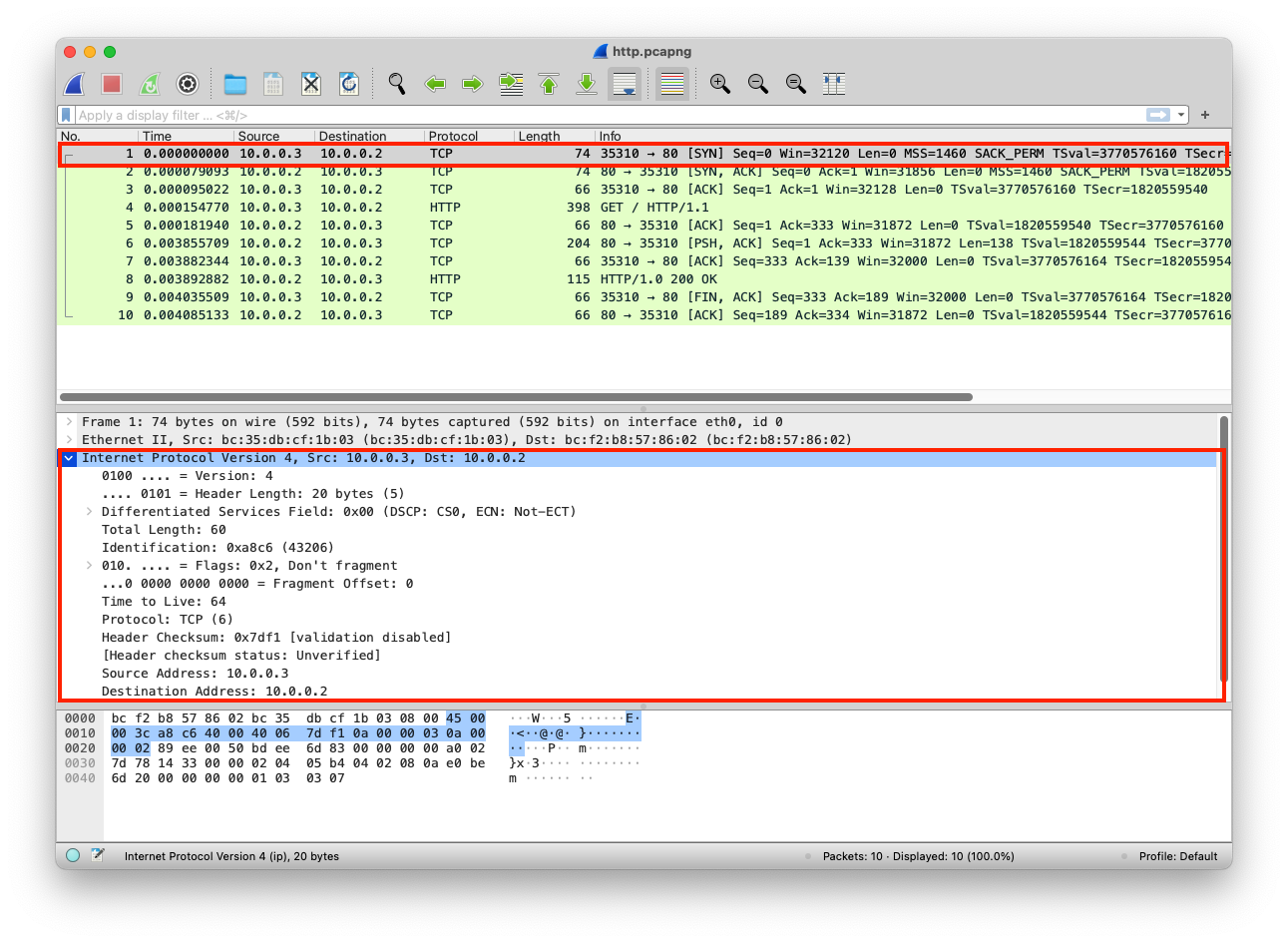
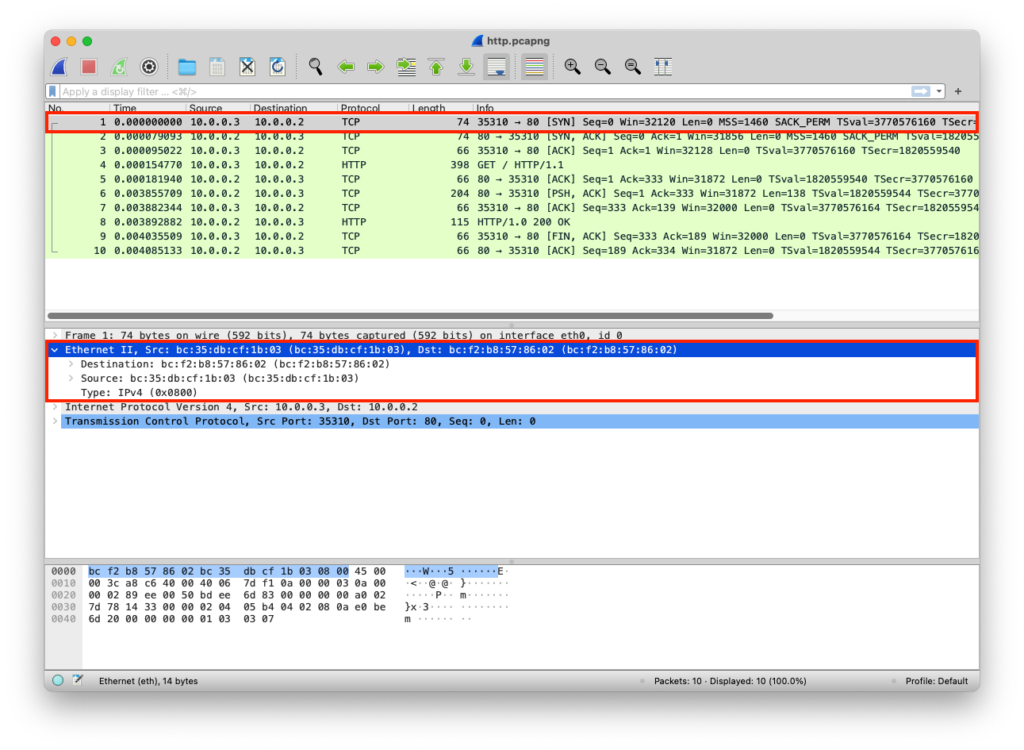
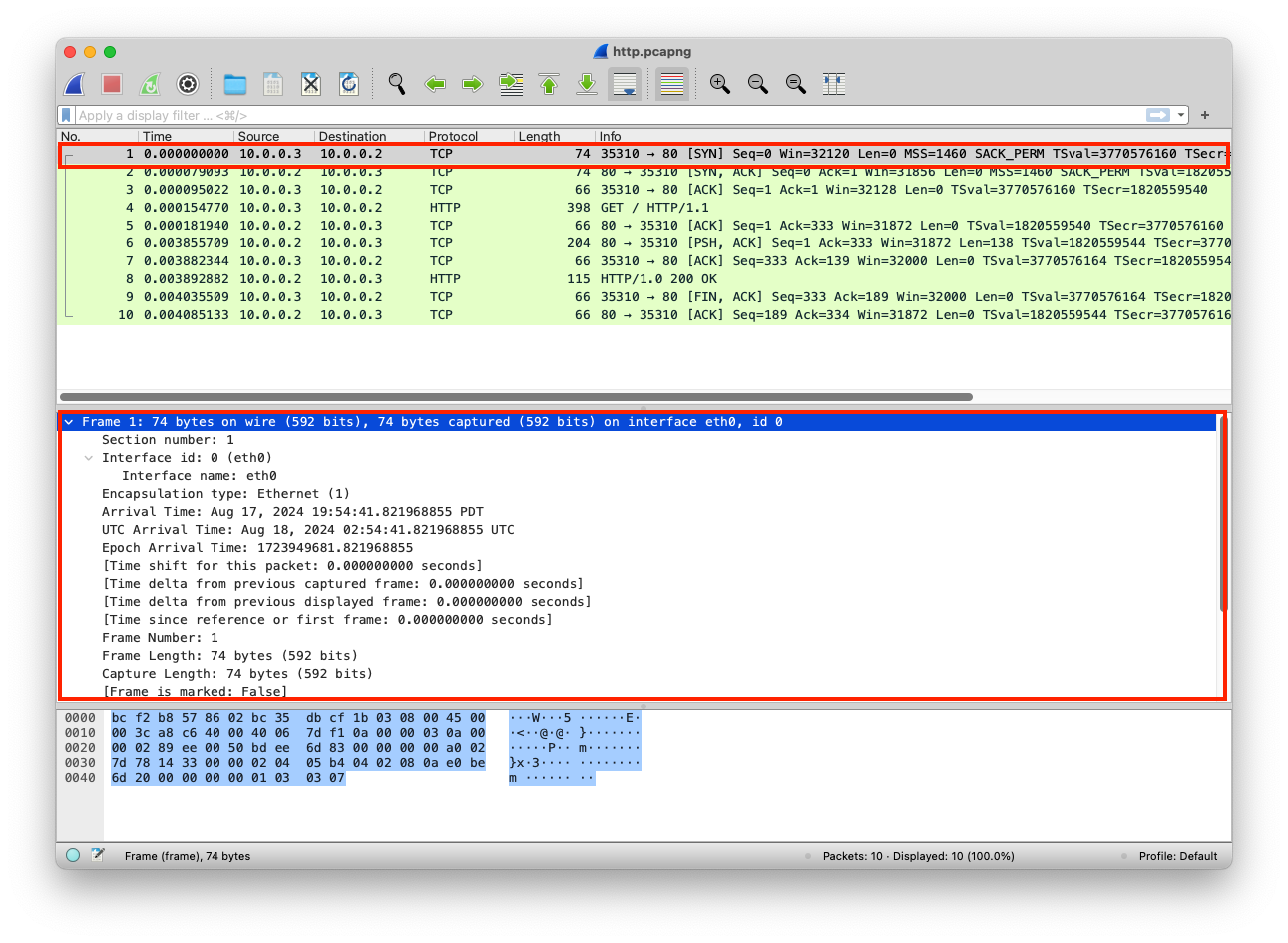
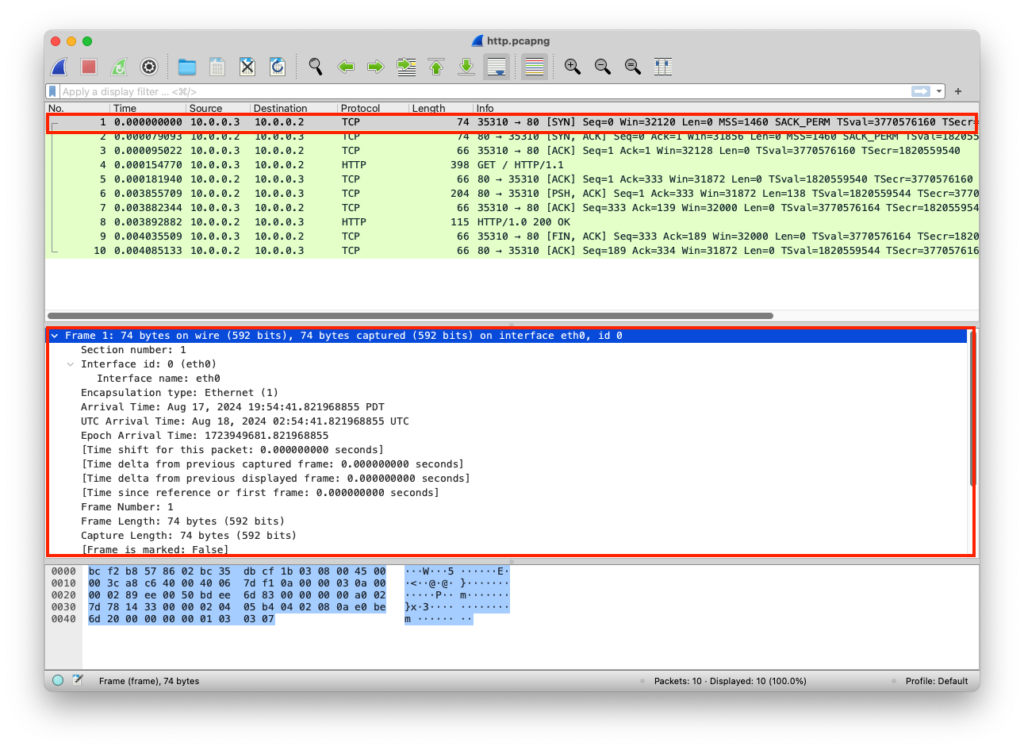
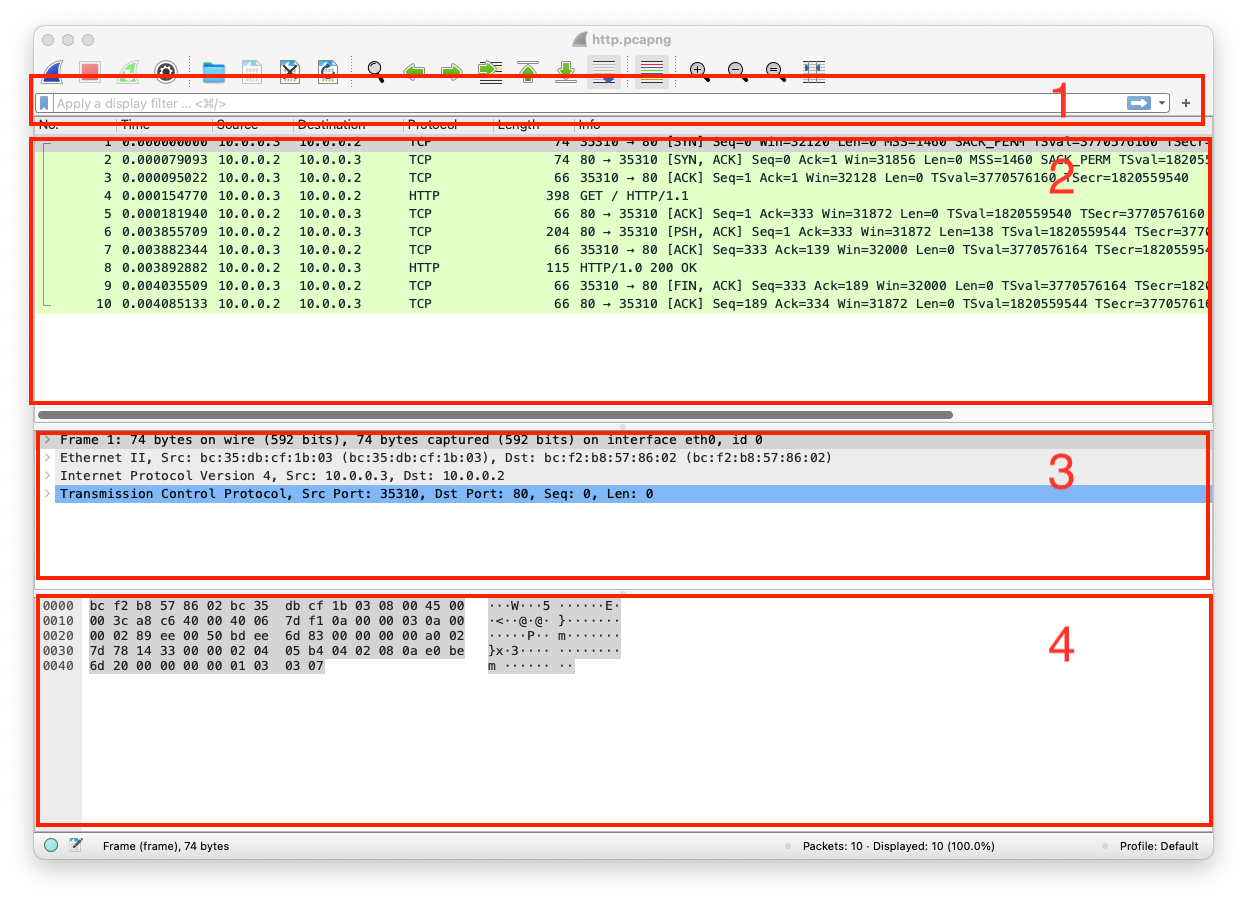
    The client requested web content from the server over an insecure protocol called HTTP, the server responded with the web content, the client received the web content and got rendered by the client’s web browser. Insecure protocols can be intercepted, and the data carried in them can be modified

    Client Sends Data

    The client requests specific web content over HTTP using the GET method

    LayerProtocolPDUInfoPortsIPsMACs
    Application LayerHTTPDataGET / HTTP/1.1 Host: 10.0.0.2 User-Agent: Mozilla/5.0 (X11; Linux x86_64; rv:109.0) Gecko/20100101 Firefox/115.0 Accept: text/html,application/xhtml+xml,application/xml;q=0.9,image/avif,image/webp,*/*;q=0.8 Accept-Language: en-US,en;q=0.5 Accept-Encoding: gzip, deflate Connection: keep-alive Upgrade-Insecure-Requests: 1
    Presentation LayerRawDataGET / HTTP/1.1\r\nHost: 10.0.0.2\r\nUser-Agent: Mozilla/5.0 (X11; Linux x86_64; rv:109.0) Gecko/20100101 Firefox/115.0\r\nAccept: text/html,application/xhtml+xml,application/xml;q=0.9,image/avif,image/webp,*/*;q=0.8\r\nAccept-Language: en-US,en;q=0.5\r\nAccept-Encoding: gzip, deflate\r\nConnection: keep-alive\r\nUpgrade-Insecure-Requests: 1
    Session LayerSocketDataGET / HTTP/1.1\r\nHost: 10.0.0.2\r\nUser-Agent: Mozilla/5.0 (X11; Linux x86_64; rv:109.0) Gecko/20100101 Firefox/115.0\r\nAccept: text/html,application/xhtml+xml,application/xml;q=0.9,image/avif,image/webp,*/*;q=0.8\r\nAccept-Language: en-US,en;q=0.5\r\nAccept-Encoding: gzip, deflate\r\nConnection: keep-alive\r\nUpgrade-Insecure-Requests: 1
    Transport LayerTCPSegmentsGET / HTTP/1.1\r\nHost: 10.0.0.2\r\nUser-Agent: Mozilla/5.0 (X11; Linux x86_64; rv:109.0) Gecko/20100101 Firefox/115.0\r\nAccept: text/html,application/xhtml+xml,application/xml;q=0.9,image/avif,image/webp,*/*;q=0.8\r\nAccept-Language: en-US,en;q=0.5\r\nAccept-Encoding: gzip, deflate\r\nConnection: keep-alive\r\nUpgrade-Insecure-Requests: 1Src Port: 35310
    Dst Port: 80
    Network LayerIPPacketsGET / HTTP/1.1\r\nHost: 10.0.0.2\r\nUser-Agent: Mozilla/5.0 (X11; Linux x86_64; rv:109.0) Gecko/20100101 Firefox/115.0\r\nAccept: text/html,application/xhtml+xml,application/xml;q=0.9,image/avif,image/webp,*/*;q=0.8\r\nAccept-Language: en-US,en;q=0.5\r\nAccept-Encoding: gzip, deflate\r\nConnection: keep-alive\r\nUpgrade-Insecure-Requests: 1Src Port: 35310
    Dst Port: 80
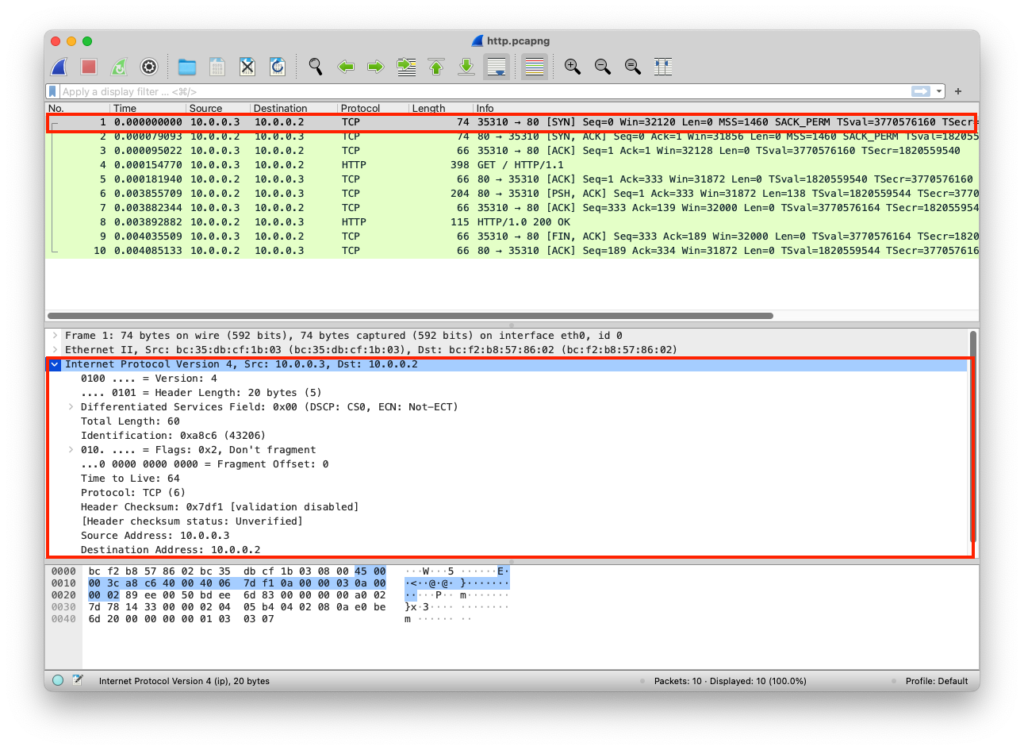
    Src IP: 10.0.0.3
    Dst IP: 10.0.0.2
    Data Link LayerEthernetFramesGET / HTTP/1.1\r\nHost: 10.0.0.2\r\nUser-Agent: Mozilla/5.0 (X11; Linux x86_64; rv:109.0) Gecko/20100101 Firefox/115.0\r\nAccept: text/html,application/xhtml+xml,application/xml;q=0.9,image/avif,image/webp,*/*;q=0.8\r\nAccept-Language: en-US,en;q=0.5\r\nAccept-Encoding: gzip, deflate\r\nConnection: keep-alive\r\nUpgrade-Insecure-Requests: 1Src Port: 35310
    Dst Port: 80
    Src IP: 10.0.0.3
    Dst IP: 10.0.0.2
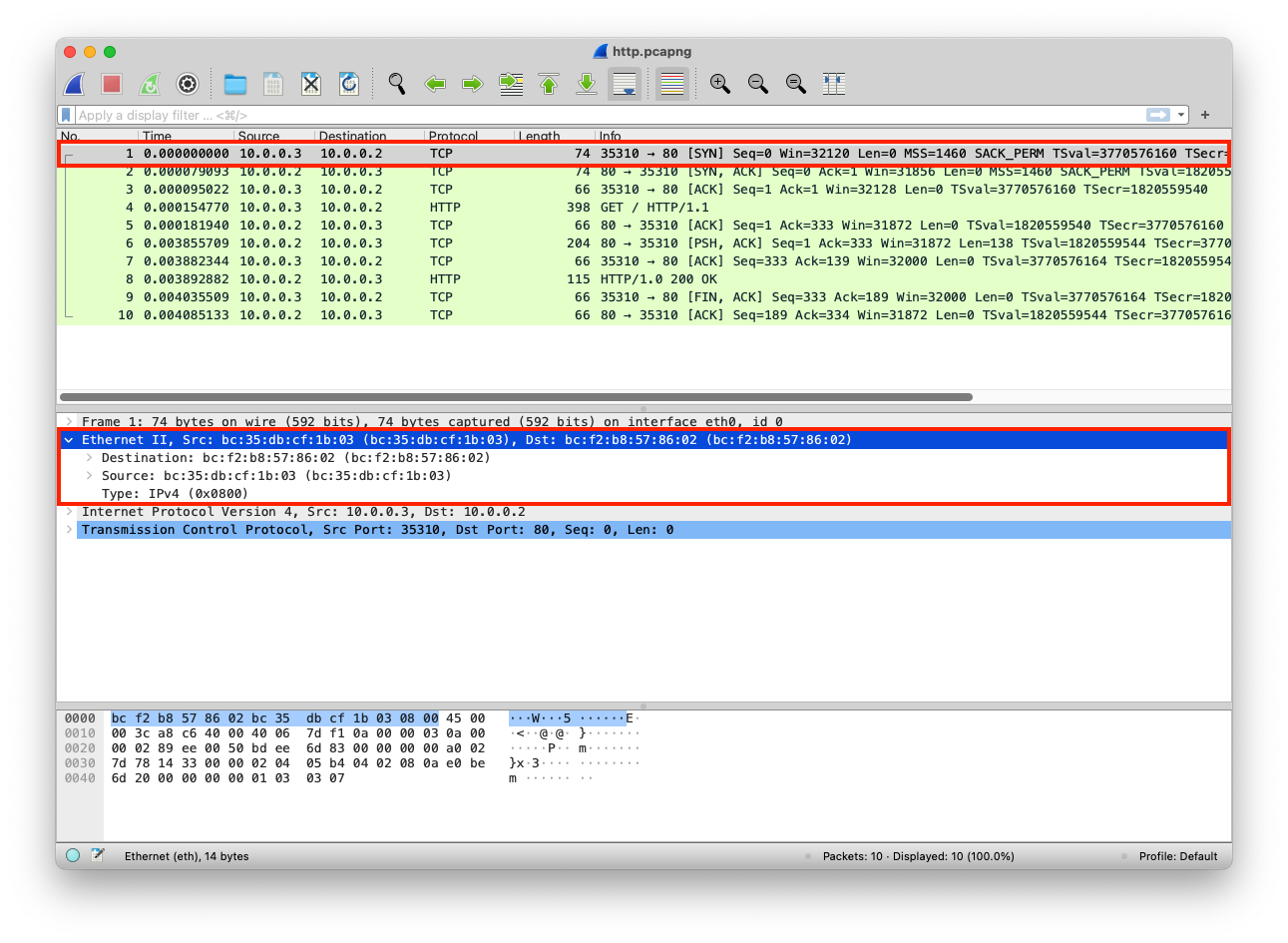
    Src MAC: bc:35:db:cf:1b:03
    Dst MAC: bc:f2:b8:57:86:02
    Physical LayerCoaxBits01001000 01010100 01010100 01010000 00101111 00110001 00101110 00110000 00100000 01001000 0101010001001000 0101010001001000 01010100

    Server Receives Data

    The server receives the client’s HTTP GET request

    LayerProtocolPDUInfoPortsIPsMACs
    Physical LayerCoaxBits01001000 01010100 01010100 01010000 00101111 00110001 00101110 00110000 00100000 01001000 0101010001001000 0101010001001000 01010100
    Data Link LayerEthernetFramesGET / HTTP/1.1\r\nHost: 10.0.0.2\r\nUser-Agent: Mozilla/5.0 (X11; Linux x86_64; rv:109.0) Gecko/20100101 Firefox/115.0\r\nAccept: text/html,application/xhtml+xml,application/xml;q=0.9,image/avif,image/webp,*/*;q=0.8\r\nAccept-Language: en-US,en;q=0.5\r\nAccept-Encoding: gzip, deflate\r\nConnection: keep-alive\r\nUpgrade-Insecure-Requests: 1Src Port: 35310
    Dst Port: 80
    Src IP: 10.0.0.3
    Dst IP: 10.0.0.2
    Src MAC: bc:35:db:cf:1b:03
    Dst MAC: bc:f2:b8:57:86:02
    Network LayerIPPacketsGET / HTTP/1.1\r\nHost: 10.0.0.2\r\nUser-Agent: Mozilla/5.0 (X11; Linux x86_64; rv:109.0) Gecko/20100101 Firefox/115.0\r\nAccept: text/html,application/xhtml+xml,application/xml;q=0.9,image/avif,image/webp,*/*;q=0.8\r\nAccept-Language: en-US,en;q=0.5\r\nAccept-Encoding: gzip, deflate\r\nConnection: keep-alive\r\nUpgrade-Insecure-Requests: 1Src Port: 35310
    Dst Port: 80
    Src IP: 10.0.0.3
    Dst IP: 10.0.0.2
    Transport LayerTCPSegmentsGET / HTTP/1.1\r\nHost: 10.0.0.2\r\nUser-Agent: Mozilla/5.0 (X11; Linux x86_64; rv:109.0) Gecko/20100101 Firefox/115.0\r\nAccept: text/html,application/xhtml+xml,application/xml;q=0.9,image/avif,image/webp,*/*;q=0.8\r\nAccept-Language: en-US,en;q=0.5\r\nAccept-Encoding: gzip, deflate\r\nConnection: keep-alive\r\nUpgrade-Insecure-Requests: 1Src Port: 35310
    Dst Port: 80
    Session LayerSocketDataGET / HTTP/1.1\r\nHost: 10.0.0.2\r\nUser-Agent: Mozilla/5.0 (X11; Linux x86_64; rv:109.0) Gecko/20100101 Firefox/115.0\r\nAccept: text/html,application/xhtml+xml,application/xml;q=0.9,image/avif,image/webp,*/*;q=0.8\r\nAccept-Language: en-US,en;q=0.5\r\nAccept-Encoding: gzip, deflate\r\nConnection: keep-alive\r\nUpgrade-Insecure-Requests: 1
    Presentation LayerRawDataGET / HTTP/1.1\r\nHost: 10.0.0.2\r\nUser-Agent: Mozilla/5.0 (X11; Linux x86_64; rv:109.0) Gecko/20100101 Firefox/115.0\r\nAccept: text/html,application/xhtml+xml,application/xml;q=0.9,image/avif,image/webp,*/*;q=0.8\r\nAccept-Language: en-US,en;q=0.5\r\nAccept-Encoding: gzip, deflate\r\nConnection: keep-alive\r\nUpgrade-Insecure-Requests: 1
    Application LayerHTTPDataGET / HTTP/1.1 Host: 10.0.0.2 User-Agent: Mozilla/5.0 (X11; Linux x86_64; rv:109.0) Gecko/20100101 Firefox/115.0 Accept: text/html,application/xhtml+xml,application/xml;q=0.9,image/avif,image/webp,*/*;q=0.8 Accept-Language: en-US,en;q=0.5 Accept-Encoding: gzip, deflate Connection: keep-alive Upgrade-Insecure-Requests: 1

    from http.server import SimpleHTTPRequestHandler # Import the built-in HTTP request handler
    from socketserver import TCPServer # Import a basic TCP server implementation
    from io import BytesIO # Import BytesIO to handle bytes in memory (for gzip compression)
    from gzip import GzipFile # Import GzipFile to compress HTTP response 
    from datetime import datetime # Import datetime to generate timestamps for logging
    from contextlib import suppress # Import suppress to prevent crashes

    with suppress(Exception): # Try importing network interface details
        from netifaces import gateways, ifaddresses, AF_INET, AF_LINK # Network interface utilities
        print(“The default network interface is: “, gateways()[‘default’][AF_INET][1]) # Display default network interface name
        print(“The default network interface mac address is: “, ifaddresses(gateways()[‘default’][AF_INET][1])[AF_LINK]) # Display MAC address of the default network interface

    class Server(SimpleHTTPRequestHandler): # Define a custom HTTP server

        def do_GET(self): # Handle HTTP GET requests
            compressed = False # Track whether gzip compression is used
            content = b'<HTML><h1>Hello World!</h1></HTML>’ # HTTP response body (bytes)

            if len(content) > 0: # Only attempt compression if content exists
                if ‘accept-encoding’ in self.headers: # Check if client sent Accept-Encoding header
                    if ‘gzip’ in self.headers[‘accept-encoding’]: # Client supports gzip
                        bytes_ = BytesIO() # Create an in-memory byte buffer
                        with GzipFile(fileobj=bytes_, mode=’w’, compresslevel=5) as f: # Gzip wrapper
                            f.write(content) # Compress the response body
                        content = bytes_.getvalue() # Replace content with compressed bytes
                        compressed = True # Mark response as compressed

            self.send_response(200) # Send HTTP 200 OK status
            if compressed:
                self.send_header(‘content-encoding’, ‘gzip’) # Notify client of gzip encoding
            self.send_header(‘content-length’, len(content)) # Send content length header
            self.end_headers() # End HTTP headers
            self.wfile.write(content) # Write response body to client

        def log_message(self, format, *args): # Override default request logging
            print(“[{}] – {}:{} – {} {}”.format( # Custom log format
                datetime.now().strftime(“%m/%d/%Y %H:%M:%S”), # Timestamp
                self.client_address[0], # Client IP address
                self.client_address[1], # Client source port
                args[0], # HTTP method
                args[1] # Requested path
            ))

    TCPServer((‘0.0.0.0’, 80), Server).serve_forever() # Start server on all interfaces, port 80

    from http.server import SimpleHTTPRequestHandler
    from socketserver import TCPServer
    from io import BytesIO
    from gzip import GzipFile
    from datetime import datetime
    from contextlib import suppress

    with suppress(Exception):
        from netifaces import gateways, ifaddresses, AF_INET, AF_LINK
        print("The default network interface is: ",gateways()['default'][AF_INET][1])
        print("The default network interface mac address is: ",ifaddresses(gateways()['default'][AF_INET][1])[AF_LINK])

    class Server(SimpleHTTPRequestHandler):
        def do_GET(self):
            compressed = False
            content = b'<HTML><h1>Hello World!</h1></HTML>'
            if len(content) > 0:
                if 'accept-encoding' in self.headers:
                    if 'gzip' in self.headers['accept-encoding']:
                        bytes_ = BytesIO()
                        with GzipFile(fileobj=bytes_, mode='w', compresslevel=5) as f:
                            f.write(content)
                            f.close()
                            content = bytes_.getvalue()
                            compressed = True
            self.send_response(200)
            if compressed:
                self.send_header('content-encoding', 'gzip')
            self.send_header('content-length', len(content))
            self.end_headers()
            self.wfile.write(content)

        def log_message(self, format, *args):
            print("[{}] - {}:{} - {} {}".format(datetime.now().strftime("%m/%d/%Y %H:%M:%S"), self.client_address[0],self.client_address[1],args[0],args[1]))

    TCPServer(('0.0.0.0', 80), Server).serve_forever()

    Server Sends Data

    The server sends the client the requested web content over HTTP

    LayerProtocolPDUInfoPortsIPsMACs
    Application LayerHTTPDataHTTP/1.0 200 OK Server: SimpleHTTP/0.6 Python/3.11.6 Date: Sun, 18 Aug 2024 02:54:42 GMT content-encoding: gzip content-length: 49

    <HTML><h1>Hello World!</h1></HTML>
    Presentation LayerGZIPDataHTTP/1.0 200 OK\r\nServer: SimpleHTTP/0.6 Python/3.11.6\r\nDate: Sun, 18 Aug 2024 02:54:42 GMT\r\ncontent-encoding: gzip\r\ncontent-length: 49\r\n\r\n….rb.f……….0..H…W../.IQ……..g..7″…
    Session LayerSocketDataHTTP/1.0 200 OK\r\nServer: SimpleHTTP/0.6 Python/3.11.6\r\nDate: Sun, 18 Aug 2024 02:54:42 GMT\r\ncontent-encoding: gzip\r\ncontent-length: 49\r\n\r\n….rb.f……….0..H…W../.IQ……..g..7″…
    Transport LayerTCPSegmentsHTTP/1.0 200 OK\r\nServer: SimpleHTTP/0.6 Python/3.11.6\r\nDate: Sun, 18 Aug 2024 02:54:42 GMT\r\ncontent-encoding: gzip\r\ncontent-length: 49\r\n\r\n….rb.f……….0..H…W../.IQ……..g..7″…Src Port: 80
    Dst Port: 35310
    Network LayerIPPacketsHTTP/1.0 200 OK\r\nServer: SimpleHTTP/0.6 Python/3.11.6\r\nDate: Sun, 18 Aug 2024 02:54:42 GMT\r\ncontent-encoding: gzip\r\ncontent-length: 49\r\n\r\n….rb.f……….0..H…W../.IQ……..g..7″…Src Port: 80
    Dst Port: 35310
    Src IP: 10.0.0.2
    Dst IP: 10.0.0.3
    Data Link LayerEthernetFramesHTTP/1.0 200 OK\r\nServer: SimpleHTTP/0.6 Python/3.11.6\r\nDate: Sun, 18 Aug 2024 02:54:42 GMT\r\ncontent-encoding: gzip\r\ncontent-length: 49\r\n\r\n….rb.f……….0..H…W../.IQ……..g..7″…Src Port: 80
    Dst Port: 35310
    Src IP: 10.0.0.2
    Dst IP: 10.0.0.3
    Src MAC: bc:f2:b8:57:86:02
    Dst MAC: bc:35:db:cf:1b:03
    Physical LayerCoaxBits01001000 01010100 01010100 01010000 00101111 00110001 00101110 00110000 00100000 01001000 0101010001001000 0101010001001000 01010100

    from http.server import SimpleHTTPRequestHandler # Import the built-in HTTP request handler
    from socketserver import TCPServer # Import a basic TCP server implementation
    from io import BytesIO # Import BytesIO to handle bytes in memory (for gzip compression)
    from gzip import GzipFile # Import GzipFile to compress HTTP response 
    from datetime import datetime # Import datetime to generate timestamps for logging
    from contextlib import suppress # Import suppress to prevent crashes

    with suppress(Exception): # Try importing network interface details
        from netifaces import gateways, ifaddresses, AF_INET, AF_LINK # Network interface utilities
        print(“The default network interface is: “, gateways()[‘default’][AF_INET][1]) # Display default network interface name
        print(“The default network interface mac address is: “, ifaddresses(gateways()[‘default’][AF_INET][1])[AF_LINK]) # Display MAC address of the default network interface

    class Server(SimpleHTTPRequestHandler): # Define a custom HTTP server

        def do_GET(self): # Handle HTTP GET requests
            compressed = False # Track whether gzip compression is used
            content = b'<HTML><h1>Hello World!</h1></HTML>’ # HTTP response body (bytes)

            if len(content) > 0: # Only attempt compression if content exists
                if ‘accept-encoding’ in self.headers: # Check if client sent Accept-Encoding header
                    if ‘gzip’ in self.headers[‘accept-encoding’]: # Client supports gzip
                        bytes_ = BytesIO() # Create an in-memory byte buffer
                        with GzipFile(fileobj=bytes_, mode=’w’, compresslevel=5) as f: # Gzip wrapper
                            f.write(content) # Compress the response body
                        content = bytes_.getvalue() # Replace content with compressed bytes
                        compressed = True # Mark response as compressed

            self.send_response(200) # Send HTTP 200 OK status
            if compressed:
                self.send_header(‘content-encoding’, ‘gzip’) # Notify client of gzip encoding
            self.send_header(‘content-length’, len(content)) # Send content length header
            self.end_headers() # End HTTP headers
            self.wfile.write(content) # Write response body to client

        def log_message(self, format, *args): # Override default request logging
            print(“[{}] – {}:{} – {} {}”.format( # Custom log format
                datetime.now().strftime(“%m/%d/%Y %H:%M:%S”), # Timestamp
                self.client_address[0], # Client IP address
                self.client_address[1], # Client source port
                args[0], # HTTP method
                args[1] # Requested path
            ))

    TCPServer((‘0.0.0.0’, 80), Server).serve_forever() # Start server on all interfaces, port 80

    from http.server import SimpleHTTPRequestHandler
    from socketserver import TCPServer
    from io import BytesIO
    from gzip import GzipFile
    from datetime import datetime
    from contextlib import suppress

    with suppress(Exception):
        from netifaces import gateways, ifaddresses, AF_INET, AF_LINK
        print("The default network interface is: ",gateways()['default'][AF_INET][1])
        print("The default network interface mac address is: ",ifaddresses(gateways()['default'][AF_INET][1])[AF_LINK])

    class Server(SimpleHTTPRequestHandler):
        def do_GET(self):
            compressed = False
            content = b'<HTML><h1>Hello World!</h1></HTML>'
            if len(content) > 0:
                if 'accept-encoding' in self.headers:
                    if 'gzip' in self.headers['accept-encoding']:
                        bytes_ = BytesIO()
                        with GzipFile(fileobj=bytes_, mode='w', compresslevel=5) as f:
                            f.write(content)
                            f.close()
                            content = bytes_.getvalue()
                            compressed = True
            self.send_response(200)
            if compressed:
                self.send_header('content-encoding', 'gzip')
            self.send_header('content-length', len(content))
            self.end_headers()
            self.wfile.write(content)

        def log_message(self, format, *args):
            print("[{}] - {}:{} - {} {}".format(datetime.now().strftime("%m/%d/%Y %H:%M:%S"), self.client_address[0],self.client_address[1],args[0],args[1]))

    TCPServer(('0.0.0.0', 80), Server).serve_forever()

    Client Receives Data

    The client receives the specific web content over HTTP and the web browser renders the HTML content

    LayerProtocolPDUInfoPortsIPsMACs
    Physical LayerCoaxBits01001000 01010100 01010100 01010000 00101111 00110001 00101110 00110000 00100000 01001000 0101010001001000 0101010001001000 01010100
    Data Link LayerEthernetFramesHTTP/1.0 200 OK\r\nServer: SimpleHTTP/0.6 Python/3.11.6\r\nDate: Sun, 18 Aug 2024 02:54:42 GMT\r\ncontent-encoding: gzip\r\ncontent-length: 49\r\n\r\n….rb.f……….0..H…W../.IQ……..g..7″…Src Port: 80
    Dst Port: 35310
    Src IP: 10.0.0.2
    Dst IP: 10.0.0.3
    Src MAC: bc:f2:b8:57:86:02
    Dst MAC: bc:35:db:cf:1b:03
    Network LayerIPPacketsHTTP/1.0 200 OK\r\nServer: SimpleHTTP/0.6 Python/3.11.6\r\nDate: Sun, 18 Aug 2024 02:54:42 GMT\r\ncontent-encoding: gzip\r\ncontent-length: 49\r\n\r\n….rb.f……….0..H…W../.IQ……..g..7″…Src Port: 80
    Dst Port: 35310
    Src IP: 10.0.0.2
    Dst IP: 10.0.0.3
    Transport LayerTCPSegmentsHTTP/1.0 200 OK\r\nServer: SimpleHTTP/0.6 Python/3.11.6\r\nDate: Sun, 18 Aug 2024 02:54:42 GMT\r\ncontent-encoding: gzip\r\ncontent-length: 49\r\n\r\n….rb.f……….0..H…W../.IQ……..g..7″…Src Port: 80
    Dst Port: 35310
    Session LayerSocketDataHTTP/1.0 200 OK\r\nServer: SimpleHTTP/0.6 Python/3.11.6\r\nDate: Sun, 18 Aug 2024 02:54:42 GMT\r\ncontent-encoding: gzip\r\ncontent-length: 49\r\n\r\n….rb.f……….0..H…W../.IQ……..g..7″…
    Presentation LayerGZIPDataHTTP/1.0 200 OK\r\nServer: SimpleHTTP/0.6 Python/3.11.6\r\nDate: Sun, 18 Aug 2024 02:54:42 GMT\r\ncontent-encoding: gzip\r\ncontent-length: 49\r\n\r\n….rb.f……….0..H…W../.IQ……..g..7″…
    Application LayerHTTPDataHTTP/1.0 200 OK Server: SimpleHTTP/0.6 Python/3.11.6 Date: Sun, 18 Aug 2024 02:54:42 GMT content-encoding: gzip content-length: 49

    <HTML><h1>Hello World!</h1></HTML>
  • Presentation Layer

    Presentation Layer

    The Presentation Layer, which is Layer 6 of the OSI model, translates data between the application layer and the network transmission format. This ensures that data sent from one device can be correctly interpreted by another, even if they use different data representations. For example, it handles conversions between character encodings such as ASCII and EBCDIC, translates between different data structures, and converts multimedia formats such as audio or video streams.

    By providing this translation function, the Presentation Layer enables applications on heterogeneous systems to communicate effectively.

    In addition to data translation, the Presentation Layer is responsible for data encryption and compression. Encryption transforms data into a secure format to protect it during transmission, while compression reduces data size to improve efficiency and save bandwidth.

    These functions ensure that data is interpretable, secure, and optimized for network transport. By handling these tasks independently of the application layer, the Presentation Layer standardizes data handling and promotes interoperability between different software and hardware systems.

    Although conceptually important, the Presentation Layer is often not explicitly implemented in modern network protocol stacks. Many of its functions, such as encryption, compression, and data formatting, are integrated into the application layer or handled by specific libraries and frameworks. This is why some protocol stacks omit a distinct Presentation Layer, but the responsibilities it defines remain essential for consistent, secure, and interpretable data exchange.

    The optional functions of the Presentation Layer include:

    • Encryption: Converting plaintext to ciphertext using a secret key
    • Decryption: Converting ciphertext back to plaintext using the same secret key
    • Compression: Reducing the number of symbols required to represent data
    • Decompression: Restoring compressed data to its original form
    • Formatting: Converting data into a standardized format for easy transmission

    GNU ZIP (GZIP)

    GNU ZIP (GZIP) is a widely used compression technology designed to reduce file size for efficient storage and transfer over networks, especially the internet. It uses the DEFLATE algorithm, which combines LZ77 compression and Huffman coding to achieve high compression ratios while maintaining reasonable processing speed.

    GZIP files are easily recognizable by their magic header 1F 8B, which identifies the format and allows software to interpret and decompress the data correctly. Commonly used in web servers, APIs, and data archival, GZIP helps reduce bandwidth usage and speeds up data transmission, making it a key tool for improving network efficiency and performance.

    To compress data using GZIP

    from gzip import compress
    compressed = compress(b"Test")
    print("Output: {}\nHex: {}".format(compressed,compressed.hex(' ')))

    Output

    Output: b'\x1f\x8b\x08\x00\xc0\xc9\xc2f\x02\xff\x0bI-.\x01\x002\xd1Mx\x04\x00\x00\x00'
    Hex: 1f 8b 08 00 c0 c9 c2 66 02 ff 0b 49 2d 2e 01 00 32 d1 4d 78 04 00 00 00

    To decompress data using GZIP

    from gzip import decompress
    compressed = decompress(b'\x1f\x8b\x08\x00\xc0\xc9\xc2f\x02\xff\x0bI-.\x01\x002\xd1Mx\x04\x00\x00\x00')
    print("Output: {}\nHex: {}".format(compressed,compressed.hex(' ')))

    Output

    Output: b'Test'
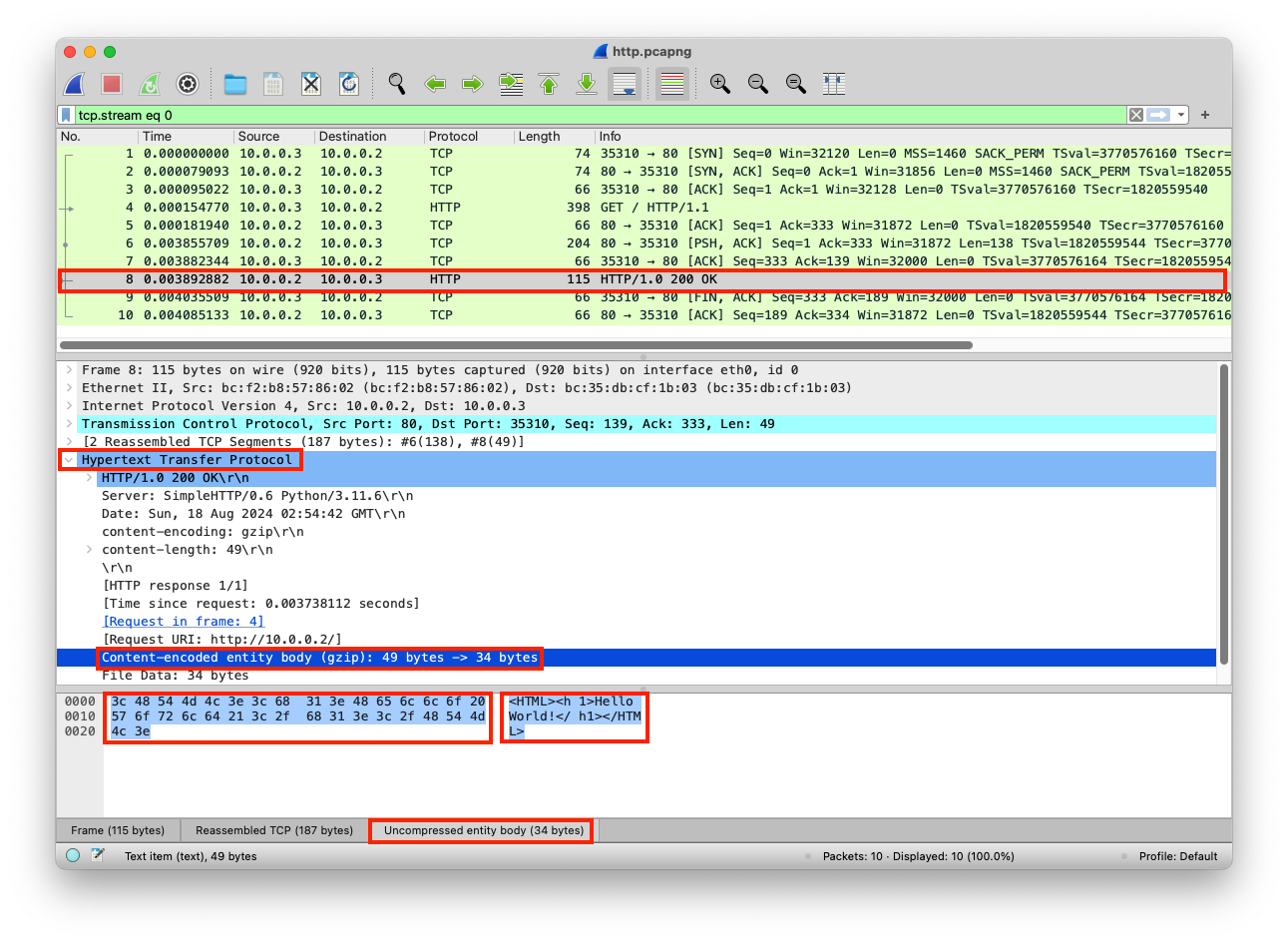
    Hex: 54 65 73 74

    PCAP Example

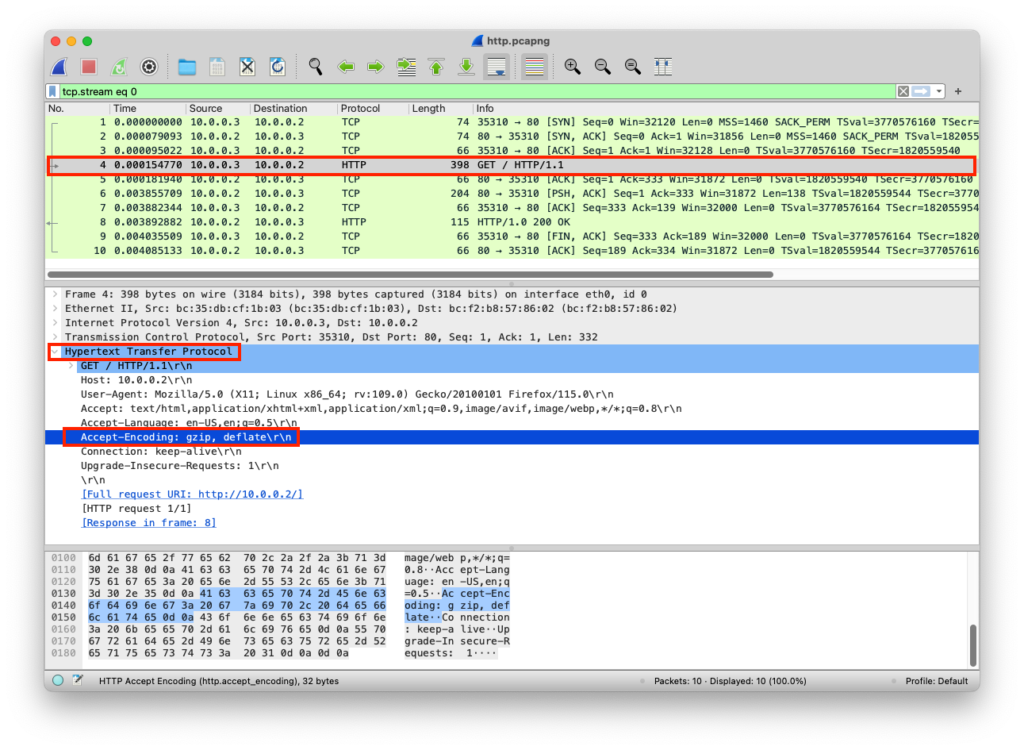
    The client requested web content from the server and indicated that it accepts GZIP content, the server responds with content that is compressed in GZIP, the client receives the GZIP and gets handled in the presentation layer

    Client Sends Data

    The client uses the HTTP Accept-Encoding header to indicate that GZIP is allowed

    LayerProtocolPDUInfoPortsIPsMACs
    Application LayerHTTPDataGET / HTTP/1.1 Host: 10.0.0.2 User-Agent: Mozilla/5.0 (X11; Linux x86_64; rv:109.0) Gecko/20100101 Firefox/115.0 Accept: text/html,application/xhtml+xml,application/xml;q=0.9,image/avif,image/webp,*/*;q=0.8 Accept-Language: en-US,en;q=0.5 Accept-Encoding: gzip, deflate Connection: keep-alive Upgrade-Insecure-Requests: 1
    Presentation LayerRawDataGET / HTTP/1.1\r\nHost: 10.0.0.2\r\nUser-Agent: Mozilla/5.0 (X11; Linux x86_64; rv:109.0) Gecko/20100101 Firefox/115.0\r\nAccept: text/html,application/xhtml+xml,application/xml;q=0.9,image/avif,image/webp,*/*;q=0.8\r\nAccept-Language: en-US,en;q=0.5\r\nAccept-Encoding: gzip, deflate\r\nConnection: keep-alive\r\nUpgrade-Insecure-Requests: 1
    Session LayerSocketDataGET / HTTP/1.1\r\nHost: 10.0.0.2\r\nUser-Agent: Mozilla/5.0 (X11; Linux x86_64; rv:109.0) Gecko/20100101 Firefox/115.0\r\nAccept: text/html,application/xhtml+xml,application/xml;q=0.9,image/avif,image/webp,*/*;q=0.8\r\nAccept-Language: en-US,en;q=0.5\r\nAccept-Encoding: gzip, deflate\r\nConnection: keep-alive\r\nUpgrade-Insecure-Requests: 1
    Transport LayerTCPSegmentsGET / HTTP/1.1\r\nHost: 10.0.0.2\r\nUser-Agent: Mozilla/5.0 (X11; Linux x86_64; rv:109.0) Gecko/20100101 Firefox/115.0\r\nAccept: text/html,application/xhtml+xml,application/xml;q=0.9,image/avif,image/webp,*/*;q=0.8\r\nAccept-Language: en-US,en;q=0.5\r\nAccept-Encoding: gzip, deflate\r\nConnection: keep-alive\r\nUpgrade-Insecure-Requests: 1Src Port: 35310
    Dst Port: 80
    Network LayerIPPacketsGET / HTTP/1.1\r\nHost: 10.0.0.2\r\nUser-Agent: Mozilla/5.0 (X11; Linux x86_64; rv:109.0) Gecko/20100101 Firefox/115.0\r\nAccept: text/html,application/xhtml+xml,application/xml;q=0.9,image/avif,image/webp,*/*;q=0.8\r\nAccept-Language: en-US,en;q=0.5\r\nAccept-Encoding: gzip, deflate\r\nConnection: keep-alive\r\nUpgrade-Insecure-Requests: 1Src Port: 35310
    Dst Port: 80
    Src IP: 10.0.0.3
    Dst IP: 10.0.0.2
    Data Link LayerEthernetFramesGET / HTTP/1.1\r\nHost: 10.0.0.2\r\nUser-Agent: Mozilla/5.0 (X11; Linux x86_64; rv:109.0) Gecko/20100101 Firefox/115.0\r\nAccept: text/html,application/xhtml+xml,application/xml;q=0.9,image/avif,image/webp,*/*;q=0.8\r\nAccept-Language: en-US,en;q=0.5\r\nAccept-Encoding: gzip, deflate\r\nConnection: keep-alive\r\nUpgrade-Insecure-Requests: 1Src Port: 35310
    Dst Port: 80
    Src IP: 10.0.0.3
    Dst IP: 10.0.0.2
    Src MAC: bc:35:db:cf:1b:03
    Dst MAC: bc:f2:b8:57:86:02
    Physical LayerCoaxBits01001000 01010100 01010100 01010000 00101111 00110001 00101110 00110000 00100000 01001000 0101010001001000 0101010001001000 01010100

    Server Receives Data

    The server receives the client’s HTTP Accept-Encoding request

    LayerProtocolPDUInfoPortsIPsMACs
    Physical LayerCoaxBits01001000 01010100 01010100 01010000 00101111 00110001 00101110 00110000 00100000 01001000 0101010001001000 0101010001001000 01010100
    Data Link LayerEthernetFramesGET / HTTP/1.1\r\nHost: 10.0.0.2\r\nUser-Agent: Mozilla/5.0 (X11; Linux x86_64; rv:109.0) Gecko/20100101 Firefox/115.0\r\nAccept: text/html,application/xhtml+xml,application/xml;q=0.9,image/avif,image/webp,*/*;q=0.8\r\nAccept-Language: en-US,en;q=0.5\r\nAccept-Encoding: gzip, deflate\r\nConnection: keep-alive\r\nUpgrade-Insecure-Requests: 1Src Port: 35310
    Dst Port: 80
    Src IP: 10.0.0.3
    Dst IP: 10.0.0.2
    Src MAC: bc:35:db:cf:1b:03
    Dst MAC: bc:f2:b8:57:86:02
    Network LayerIPPacketsGET / HTTP/1.1\r\nHost: 10.0.0.2\r\nUser-Agent: Mozilla/5.0 (X11; Linux x86_64; rv:109.0) Gecko/20100101 Firefox/115.0\r\nAccept: text/html,application/xhtml+xml,application/xml;q=0.9,image/avif,image/webp,*/*;q=0.8\r\nAccept-Language: en-US,en;q=0.5\r\nAccept-Encoding: gzip, deflate\r\nConnection: keep-alive\r\nUpgrade-Insecure-Requests: 1Src Port: 35310
    Dst Port: 80
    Src IP: 10.0.0.3
    Dst IP: 10.0.0.2
    Transport LayerTCPSegmentsGET / HTTP/1.1\r\nHost: 10.0.0.2\r\nUser-Agent: Mozilla/5.0 (X11; Linux x86_64; rv:109.0) Gecko/20100101 Firefox/115.0\r\nAccept: text/html,application/xhtml+xml,application/xml;q=0.9,image/avif,image/webp,*/*;q=0.8\r\nAccept-Language: en-US,en;q=0.5\r\nAccept-Encoding: gzip, deflate\r\nConnection: keep-alive\r\nUpgrade-Insecure-Requests: 1Src Port: 35310
    Dst Port: 80
    Session LayerSocketDataGET / HTTP/1.1\r\nHost: 10.0.0.2\r\nUser-Agent: Mozilla/5.0 (X11; Linux x86_64; rv:109.0) Gecko/20100101 Firefox/115.0\r\nAccept: text/html,application/xhtml+xml,application/xml;q=0.9,image/avif,image/webp,*/*;q=0.8\r\nAccept-Language: en-US,en;q=0.5\r\nAccept-Encoding: gzip, deflate\r\nConnection: keep-alive\r\nUpgrade-Insecure-Requests: 1
    Presentation LayerRawDataGET / HTTP/1.1\r\nHost: 10.0.0.2\r\nUser-Agent: Mozilla/5.0 (X11; Linux x86_64; rv:109.0) Gecko/20100101 Firefox/115.0\r\nAccept: text/html,application/xhtml+xml,application/xml;q=0.9,image/avif,image/webp,*/*;q=0.8\r\nAccept-Language: en-US,en;q=0.5\r\nAccept-Encoding: gzip, deflate\r\nConnection: keep-alive\r\nUpgrade-Insecure-Requests: 1
    Application LayerHTTPDataGET / HTTP/1.1 Host: 10.0.0.2 User-Agent: Mozilla/5.0 (X11; Linux x86_64; rv:109.0) Gecko/20100101 Firefox/115.0 Accept: text/html,application/xhtml+xml,application/xml;q=0.9,image/avif,image/webp,*/*;q=0.8 Accept-Language: en-US,en;q=0.5 Accept-Encoding: gzip, deflate Connection: keep-alive Upgrade-Insecure-Requests: 1

    from http.server import SimpleHTTPRequestHandler # Import the built-in HTTP request handler
    from socketserver import TCPServer # Import a basic TCP server implementation
    from io import BytesIO # Import BytesIO to handle bytes in memory (for gzip compression)
    from gzip import GzipFile # Import GzipFile to compress HTTP response 
    from datetime import datetime # Import datetime to generate timestamps for logging
    from contextlib import suppress # Import suppress to prevent crashes

    with suppress(Exception): # Try importing network interface details
        from netifaces import gateways, ifaddresses, AF_INET, AF_LINK # Network interface utilities
        print(“The default network interface is: “, gateways()[‘default’][AF_INET][1]) # Display default network interface name
        print(“The default network interface mac address is: “, ifaddresses(gateways()[‘default’][AF_INET][1])[AF_LINK]) # Display MAC address of the default network interface

    class Server(SimpleHTTPRequestHandler): # Define a custom HTTP server

        def do_GET(self): # Handle HTTP GET requests
            compressed = False # Track whether gzip compression is used
            content = b'<HTML><h1>Hello World!</h1></HTML>’ # HTTP response body (bytes)

            if len(content) > 0: # Only attempt compression if content exists
                if ‘accept-encoding’ in self.headers: # Check if client sent Accept-Encoding header
                    if ‘gzip’ in self.headers[‘accept-encoding’]: # Client supports gzip
                        bytes_ = BytesIO() # Create an in-memory byte buffer
                        with GzipFile(fileobj=bytes_, mode=’w’, compresslevel=5) as f: # Gzip wrapper
                            f.write(content) # Compress the response body
                        content = bytes_.getvalue() # Replace content with compressed bytes
                        compressed = True # Mark response as compressed

            self.send_response(200) # Send HTTP 200 OK status
            if compressed:
                self.send_header(‘content-encoding’, ‘gzip’) # Notify client of gzip encoding
            self.send_header(‘content-length’, len(content)) # Send content length header
            self.end_headers() # End HTTP headers
            self.wfile.write(content) # Write response body to client

        def log_message(self, format, *args): # Override default request logging
            print(“[{}] – {}:{} – {} {}”.format( # Custom log format
                datetime.now().strftime(“%m/%d/%Y %H:%M:%S”), # Timestamp
                self.client_address[0], # Client IP address
                self.client_address[1], # Client source port
                args[0], # HTTP method
                args[1] # Requested path
            ))

    TCPServer((‘0.0.0.0’, 80), Server).serve_forever() # Start server on all interfaces, port 80

    from http.server import SimpleHTTPRequestHandler
    from socketserver import TCPServer
    from io import BytesIO
    from gzip import GzipFile
    from datetime import datetime
    from contextlib import suppress

    with suppress(Exception):
        from netifaces import gateways, ifaddresses, AF_INET, AF_LINK
        print("The default network interface is: ",gateways()['default'][AF_INET][1])
        print("The default network interface mac address is: ",ifaddresses(gateways()['default'][AF_INET][1])[AF_LINK])

    class Server(SimpleHTTPRequestHandler):
        def do_GET(self):
            compressed = False
            content = b'<HTML><h1>Hello World!</h1></HTML>'
            if len(content) > 0:
                if 'accept-encoding' in self.headers:
                    if 'gzip' in self.headers['accept-encoding']:
                        bytes_ = BytesIO()
                        with GzipFile(fileobj=bytes_, mode='w', compresslevel=5) as f:
                            f.write(content)
                            f.close()
                            content = bytes_.getvalue()
                            compressed = True
            self.send_response(200)
            if compressed:
                self.send_header('content-encoding', 'gzip')
            self.send_header('content-length', len(content))
            self.end_headers()
            self.wfile.write(content)

        def log_message(self, format, *args):
            print("[{}] - {}:{} - {} {}".format(datetime.now().strftime("%m/%d/%Y %H:%M:%S"), self.client_address[0],self.client_address[1],args[0],args[1]))

    TCPServer(('0.0.0.0', 80), Server).serve_forever()

    Server Sends Data

    The server compresses and sends the compressed web content

    LayerProtocolPDUInfoPortsIPsMACs
    Application LayerHTTPDataHTTP/1.0 200 OK Server: SimpleHTTP/0.6 Python/3.11.6 Date: Sun, 18 Aug 2024 02:54:42 GMT content-encoding: gzip content-length: 49

    <HTML><h1>Hello World!</h1></HTML>
    Presentation LayerGZIPDataHTTP/1.0 200 OK\r\nServer: SimpleHTTP/0.6 Python/3.11.6\r\nDate: Sun, 18 Aug 2024 02:54:42 GMT\r\ncontent-encoding: gzip\r\ncontent-length: 49\r\n\r\n….rb.f……….0..H…W../.IQ……..g..7″…
    Session LayerSocketDataHTTP/1.0 200 OK\r\nServer: SimpleHTTP/0.6 Python/3.11.6\r\nDate: Sun, 18 Aug 2024 02:54:42 GMT\r\ncontent-encoding: gzip\r\ncontent-length: 49\r\n\r\n….rb.f……….0..H…W../.IQ……..g..7″…
    Transport LayerTCPSegmentsHTTP/1.0 200 OK\r\nServer: SimpleHTTP/0.6 Python/3.11.6\r\nDate: Sun, 18 Aug 2024 02:54:42 GMT\r\ncontent-encoding: gzip\r\ncontent-length: 49\r\n\r\n….rb.f……….0..H…W../.IQ……..g..7″…Src Port: 80
    Dst Port: 35310
    Network LayerIPPacketsHTTP/1.0 200 OK\r\nServer: SimpleHTTP/0.6 Python/3.11.6\r\nDate: Sun, 18 Aug 2024 02:54:42 GMT\r\ncontent-encoding: gzip\r\ncontent-length: 49\r\n\r\n….rb.f……….0..H…W../.IQ……..g..7″…Src Port: 80
    Dst Port: 35310
    Src IP: 10.0.0.2
    Dst IP: 10.0.0.3
    Data Link LayerEthernetFramesHTTP/1.0 200 OK\r\nServer: SimpleHTTP/0.6 Python/3.11.6\r\nDate: Sun, 18 Aug 2024 02:54:42 GMT\r\ncontent-encoding: gzip\r\ncontent-length: 49\r\n\r\n….rb.f……….0..H…W../.IQ……..g..7″…Src Port: 80
    Dst Port: 35310
    Src IP: 10.0.0.2
    Dst IP: 10.0.0.3
    Src MAC: bc:f2:b8:57:86:02
    Dst MAC: bc:35:db:cf:1b:03
    Physical LayerCoaxBits01001000 01010100 01010100 01010000 00101111 00110001 00101110 00110000 00100000 01001000 0101010001001000 0101010001001000 01010100

    from http.server import SimpleHTTPRequestHandler # Import the built-in HTTP request handler
    from socketserver import TCPServer # Import a basic TCP server implementation
    from io import BytesIO # Import BytesIO to handle bytes in memory (for gzip compression)
    from gzip import GzipFile # Import GzipFile to compress HTTP response 
    from datetime import datetime # Import datetime to generate timestamps for logging
    from contextlib import suppress # Import suppress to prevent crashes

    with suppress(Exception): # Try importing network interface details
        from netifaces import gateways, ifaddresses, AF_INET, AF_LINK # Network interface utilities
        print(“The default network interface is: “, gateways()[‘default’][AF_INET][1]) # Display default network interface name
        print(“The default network interface mac address is: “, ifaddresses(gateways()[‘default’][AF_INET][1])[AF_LINK]) # Display MAC address of the default network interface

    class Server(SimpleHTTPRequestHandler): # Define a custom HTTP server

        def do_GET(self): # Handle HTTP GET requests
            compressed = False # Track whether gzip compression is used
            content = b'<HTML><h1>Hello World!</h1></HTML>’ # HTTP response body (bytes)

            if len(content) > 0: # Only attempt compression if content exists
                if ‘accept-encoding’ in self.headers: # Check if client sent Accept-Encoding header
                    if ‘gzip’ in self.headers[‘accept-encoding’]: # Client supports gzip
                        bytes_ = BytesIO() # Create an in-memory byte buffer
                        with GzipFile(fileobj=bytes_, mode=’w’, compresslevel=5) as f: # Gzip wrapper
                            f.write(content) # Compress the response body
                        content = bytes_.getvalue() # Replace content with compressed bytes
                        compressed = True # Mark response as compressed

            self.send_response(200) # Send HTTP 200 OK status
            if compressed:
                self.send_header(‘content-encoding’, ‘gzip’) # Notify client of gzip encoding
            self.send_header(‘content-length’, len(content)) # Send content length header
            self.end_headers() # End HTTP headers
            self.wfile.write(content) # Write response body to client

        def log_message(self, format, *args): # Override default request logging
            print(“[{}] – {}:{} – {} {}”.format( # Custom log format
                datetime.now().strftime(“%m/%d/%Y %H:%M:%S”), # Timestamp
                self.client_address[0], # Client IP address
                self.client_address[1], # Client source port
                args[0], # HTTP method
                args[1] # Requested path
            ))

    TCPServer((‘0.0.0.0’, 80), Server).serve_forever() # Start server on all interfaces, port 80

    from http.server import SimpleHTTPRequestHandler
    from socketserver import TCPServer
    from io import BytesIO
    from gzip import GzipFile
    from datetime import datetime
    from contextlib import suppress

    with suppress(Exception):
        from netifaces import gateways, ifaddresses, AF_INET, AF_LINK
        print("The default network interface is: ",gateways()['default'][AF_INET][1])
        print("The default network interface mac address is: ",ifaddresses(gateways()['default'][AF_INET][1])[AF_LINK])

    class Server(SimpleHTTPRequestHandler):
        def do_GET(self):
            compressed = False
            content = b'<HTML><h1>Hello World!</h1></HTML>'
            if len(content) > 0:
                if 'accept-encoding' in self.headers:
                    if 'gzip' in self.headers['accept-encoding']:
                        bytes_ = BytesIO()
                        with GzipFile(fileobj=bytes_, mode='w', compresslevel=5) as f:
                            f.write(content)
                            f.close()
                            content = bytes_.getvalue()
                            compressed = True
            self.send_response(200)
            if compressed:
                self.send_header('content-encoding', 'gzip')
            self.send_header('content-length', len(content))
            self.end_headers()
            self.wfile.write(content)

        def log_message(self, format, *args):
            print("[{}] - {}:{} - {} {}".format(datetime.now().strftime("%m/%d/%Y %H:%M:%S"), self.client_address[0],self.client_address[1],args[0],args[1]))

    TCPServer(('0.0.0.0', 80), Server).serve_forever()

    Client Receives Data

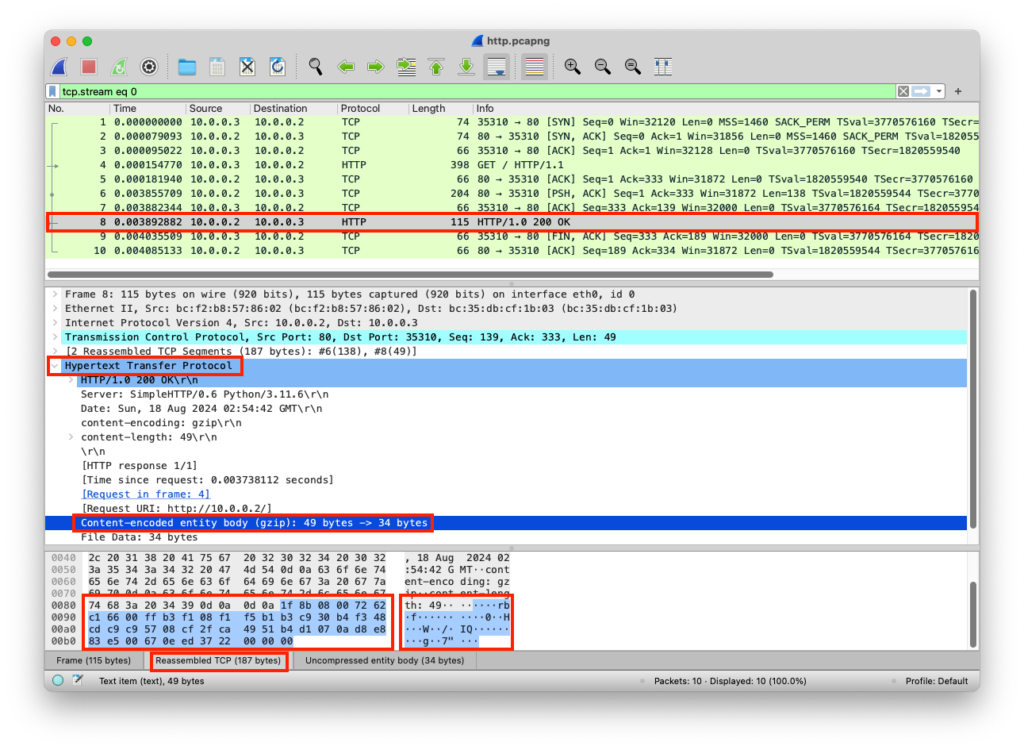
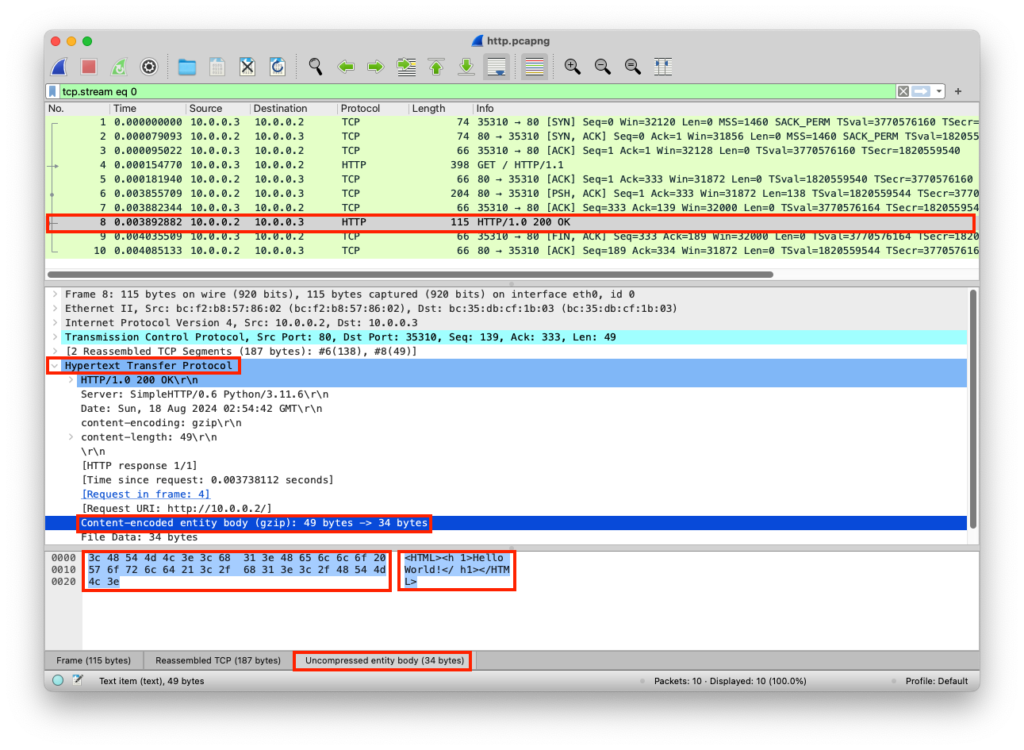
    Wireshark decompresses the content (The web browser does that as well in the background, and there will be a tab at the bottom that has the decompressed content)

    LayerProtocolPDUInfoPortsIPsMACs
    Physical LayerCoaxBits01001000 01010100 01010100 01010000 00101111 00110001 00101110 00110000 00100000 01001000 0101010001001000 0101010001001000 01010100
    Data Link LayerEthernetFramesHTTP/1.0 200 OK\r\nServer: SimpleHTTP/0.6 Python/3.11.6\r\nDate: Sun, 18 Aug 2024 02:54:42 GMT\r\ncontent-encoding: gzip\r\ncontent-length: 49\r\n\r\n….rb.f……….0..H…W../.IQ……..g..7″…Src Port: 80
    Dst Port: 35310
    Src IP: 10.0.0.2
    Dst IP: 10.0.0.3
    Src MAC: bc:f2:b8:57:86:02
    Dst MAC: bc:35:db:cf:1b:03
    Network LayerIPPacketsHTTP/1.0 200 OK\r\nServer: SimpleHTTP/0.6 Python/3.11.6\r\nDate: Sun, 18 Aug 2024 02:54:42 GMT\r\ncontent-encoding: gzip\r\ncontent-length: 49\r\n\r\n….rb.f……….0..H…W../.IQ……..g..7″…Src Port: 80
    Dst Port: 35310
    Src IP: 10.0.0.2
    Dst IP: 10.0.0.3
    Transport LayerTCPSegmentsHTTP/1.0 200 OK\r\nServer: SimpleHTTP/0.6 Python/3.11.6\r\nDate: Sun, 18 Aug 2024 02:54:42 GMT\r\ncontent-encoding: gzip\r\ncontent-length: 49\r\n\r\n….rb.f……….0..H…W../.IQ……..g..7″…Src Port: 80
    Dst Port: 35310
    Session LayerSocketDataHTTP/1.0 200 OK\r\nServer: SimpleHTTP/0.6 Python/3.11.6\r\nDate: Sun, 18 Aug 2024 02:54:42 GMT\r\ncontent-encoding: gzip\r\ncontent-length: 49\r\n\r\n….rb.f……….0..H…W../.IQ……..g..7″…
    Presentation LayerGZIPDataHTTP/1.0 200 OK\r\nServer: SimpleHTTP/0.6 Python/3.11.6\r\nDate: Sun, 18 Aug 2024 02:54:42 GMT\r\ncontent-encoding: gzip\r\ncontent-length: 49\r\n\r\n….rb.f……….0..H…W../.IQ……..g..7″…
    Application LayerHTTPDataHTTP/1.0 200 OK Server: SimpleHTTP/0.6 Python/3.11.6 Date: Sun, 18 Aug 2024 02:54:42 GMT content-encoding: gzip content-length: 49

    <HTML><h1>Hello World!</h1></HTML>

  • Session Layer

    Session Layer

    Session Layer

    The Session Layer, Layer 5 of the OSI model, manages communication sessions between networked devices. A session is a logical channel that enables two nodes to exchange data in an organized manner. This layer ensures reliable communication by controlling when conversations start and end, maintaining context for accurate data interpretation.

    Beyond opening and closing sessions, the Session Layer provides synchronization and checkpointing mechanisms. It inserts markers in data streams so interrupted sessions can resume from the last checkpoint instead of restarting. This is particularly beneficial for long-running processes such as file transfers, database queries, or video streaming, as it enhances efficiency and reliability by reducing retransmissions.

    While many modern protocols integrate session management into the Transport or Application layers, the Session Layer conceptually separates these responsibilities. It also interacts with authentication and security mechanisms to control access, ensuring only authorized applications or users can communicate. By handling these tasks, the Session Layer establishes a framework for reliable, organized, and stateful communication between devices.


    Socket

    A socket is a software interface that enables processes or applications to communicate with the Transport Layer of a network stack. It serves as an endpoint for sending and receiving data, providing a standardized way for programs to establish connections, transmit information, and interact with network services.

    Each socket is uniquely identified by a combination of an IP address and a port number, defining the communication channel between two devices. Using sockets, applications can leverage transport protocols like TCP or UDP to exchange data reliably or quickly, depending on the protocol. This approach allows applications to avoid managing low-level details such as packet transmission, routing, and error handling directly.

    Active Socket

    The client uses an active socket to initiate a TCP connection. The process involves:

    • Create a socket
    • Connect to a server

    nc # Netcat, a networking utility used to read/write data over TCP or UDP
    192.168.1.1 # Target IP address (usually a local network device like a router or server)
    1234 # Target port number to connect to on the remote system

    (Client) nc 192.168.1.1 1234

    Passive Socket

    The server uses a passive socket to wait for incoming TCP connections. The process involves:

    • Create a socket
    • Bind IP and Port
    • Listen to connections
    • Accept a connection

    nc # Netcat, networking utility for reading/writing data over TCP or UDP
    -l # Listen mode, wait for an incoming connection instead of initiating one
    1234 # Local port number to listen on

    (Server) nc -l 1234

    Authentication

    Authentication verifies that a claimed identity is valid by ensuring the person, device, or system is who or what it claims to be. This serves as a critical security measure, preventing unauthorized access to sensitive data, applications, or systems.

    Authentication can use various methods, including knowledge-based credentials (such as passwords or PINs), possession-based credentials (such as security tokens or smart cards), and inherent characteristics (such as fingerprints, facial recognition, or iris scans). By accurately verifying identities, authentication protects resources and establishes trust between users, devices, and systems in digital environments.


    Authorization

    Authorization determines whether a verified user, device, or system has the necessary permissions to access a resource or perform a specific action. After authentication confirms the identity, authorization enforces rules and policies to control what the entity can do, such as reading files, executing commands, or accessing certain network services.

    This process is managed through methods such as access control lists, role-based access controls, and policy-based systems. Effective authorization ensures that even authenticated users are restricted to only permitted operations, protecting sensitive data, maintaining system integrity, and preventing unauthorized actions in digital environments.


    Cyberattacks

    • Session Hijacking: A threat actor accesses the user’s account using a stolen or leaked valid (existing) session identifier
    • Session Fixation: A threat actor may trick a user into using a known session identifier to log in. after logging in, the session identifier is used to gain access to the user’s account.
    • Session Replay: A threat actor may re-use a stolen or leaked session identifier to access the user’s account

    PCAP Example

    The client requested web content from the server, the client created a session for handling the connection.

    Client initiates Session

    The client browser creates an active socket to communicate with the server

    LayerProtocolPDUInfoPortsIPsMACs
    Application LayerHTTPDataGET / HTTP/1.1 Host: 10.0.0.2 User-Agent: Mozilla/5.0 (X11; Linux x86_64; rv:109.0) Gecko/20100101 Firefox/115.0 Accept: text/html,application/xhtml+xml,application/xml;q=0.9,image/avif,image/webp,*/*;q=0.8 Accept-Language: en-US,en;q=0.5 Accept-Encoding: gzip, deflate Connection: keep-alive Upgrade-Insecure-Requests: 1
    Presentation LayerRawDataGET / HTTP/1.1\r\nHost: 10.0.0.2\r\nUser-Agent: Mozilla/5.0 (X11; Linux x86_64; rv:109.0) Gecko/20100101 Firefox/115.0\r\nAccept: text/html,application/xhtml+xml,application/xml;q=0.9,image/avif,image/webp,*/*;q=0.8\r\nAccept-Language: en-US,en;q=0.5\r\nAccept-Encoding: gzip, deflate\r\nConnection: keep-alive\r\nUpgrade-Insecure-Requests: 1
    Session LayerSocketDataGET / HTTP/1.1\r\nHost: 10.0.0.2\r\nUser-Agent: Mozilla/5.0 (X11; Linux x86_64; rv:109.0) Gecko/20100101 Firefox/115.0\r\nAccept: text/html,application/xhtml+xml,application/xml;q=0.9,image/avif,image/webp,*/*;q=0.8\r\nAccept-Language: en-US,en;q=0.5\r\nAccept-Encoding: gzip, deflate\r\nConnection: keep-alive\r\nUpgrade-Insecure-Requests: 1
    Transport LayerTCPSegmentsGET / HTTP/1.1\r\nHost: 10.0.0.2\r\nUser-Agent: Mozilla/5.0 (X11; Linux x86_64; rv:109.0) Gecko/20100101 Firefox/115.0\r\nAccept: text/html,application/xhtml+xml,application/xml;q=0.9,image/avif,image/webp,*/*;q=0.8\r\nAccept-Language: en-US,en;q=0.5\r\nAccept-Encoding: gzip, deflate\r\nConnection: keep-alive\r\nUpgrade-Insecure-Requests: 1Src Port: 35310
    Dst Port: 80
    Network LayerIPPacketsGET / HTTP/1.1\r\nHost: 10.0.0.2\r\nUser-Agent: Mozilla/5.0 (X11; Linux x86_64; rv:109.0) Gecko/20100101 Firefox/115.0\r\nAccept: text/html,application/xhtml+xml,application/xml;q=0.9,image/avif,image/webp,*/*;q=0.8\r\nAccept-Language: en-US,en;q=0.5\r\nAccept-Encoding: gzip, deflate\r\nConnection: keep-alive\r\nUpgrade-Insecure-Requests: 1Src Port: 35310
    Dst Port: 80
    Src IP: 10.0.0.3
    Dst IP: 10.0.0.2
    Data Link LayerEthernetFramesGET / HTTP/1.1\r\nHost: 10.0.0.2\r\nUser-Agent: Mozilla/5.0 (X11; Linux x86_64; rv:109.0) Gecko/20100101 Firefox/115.0\r\nAccept: text/html,application/xhtml+xml,application/xml;q=0.9,image/avif,image/webp,*/*;q=0.8\r\nAccept-Language: en-US,en;q=0.5\r\nAccept-Encoding: gzip, deflate\r\nConnection: keep-alive\r\nUpgrade-Insecure-Requests: 1Src Port: 35310
    Dst Port: 80
    Src IP: 10.0.0.3
    Dst IP: 10.0.0.2
    Src MAC: bc:35:db:cf:1b:03
    Dst MAC: bc:f2:b8:57:86:02
    Physical LayerCoaxBits01001000 01010100 01010100 01010000 00101111 00110001 00101110 00110000 00100000 01001000 0101010001001000 0101010001001000 01010100

    Server Accepts Session

    The server has a passive socket that accepts the client’s connection

    LayerProtocolPDUInfoPortsIPsMACs
    Physical LayerCoaxBits01001000 01010100 01010100 01010000 00101111 00110001 00101110 00110000 00100000 01001000 0101010001001000 0101010001001000 01010100
    Data Link LayerEthernetFramesGET / HTTP/1.1\r\nHost: 10.0.0.2\r\nUser-Agent: Mozilla/5.0 (X11; Linux x86_64; rv:109.0) Gecko/20100101 Firefox/115.0\r\nAccept: text/html,application/xhtml+xml,application/xml;q=0.9,image/avif,image/webp,*/*;q=0.8\r\nAccept-Language: en-US,en;q=0.5\r\nAccept-Encoding: gzip, deflate\r\nConnection: keep-alive\r\nUpgrade-Insecure-Requests: 1Src Port: 35310
    Dst Port: 80
    Src IP: 10.0.0.3
    Dst IP: 10.0.0.2
    Src MAC: bc:35:db:cf:1b:03
    Dst MAC: bc:f2:b8:57:86:02
    Network LayerIPPacketsGET / HTTP/1.1\r\nHost: 10.0.0.2\r\nUser-Agent: Mozilla/5.0 (X11; Linux x86_64; rv:109.0) Gecko/20100101 Firefox/115.0\r\nAccept: text/html,application/xhtml+xml,application/xml;q=0.9,image/avif,image/webp,*/*;q=0.8\r\nAccept-Language: en-US,en;q=0.5\r\nAccept-Encoding: gzip, deflate\r\nConnection: keep-alive\r\nUpgrade-Insecure-Requests: 1Src Port: 35310
    Dst Port: 80
    Src IP: 10.0.0.3
    Dst IP: 10.0.0.2
    Transport LayerTCPSegmentsGET / HTTP/1.1\r\nHost: 10.0.0.2\r\nUser-Agent: Mozilla/5.0 (X11; Linux x86_64; rv:109.0) Gecko/20100101 Firefox/115.0\r\nAccept: text/html,application/xhtml+xml,application/xml;q=0.9,image/avif,image/webp,*/*;q=0.8\r\nAccept-Language: en-US,en;q=0.5\r\nAccept-Encoding: gzip, deflate\r\nConnection: keep-alive\r\nUpgrade-Insecure-Requests: 1Src Port: 35310
    Dst Port: 80
    Session LayerSocketDataGET / HTTP/1.1\r\nHost: 10.0.0.2\r\nUser-Agent: Mozilla/5.0 (X11; Linux x86_64; rv:109.0) Gecko/20100101 Firefox/115.0\r\nAccept: text/html,application/xhtml+xml,application/xml;q=0.9,image/avif,image/webp,*/*;q=0.8\r\nAccept-Language: en-US,en;q=0.5\r\nAccept-Encoding: gzip, deflate\r\nConnection: keep-alive\r\nUpgrade-Insecure-Requests: 1
    Presentation LayerRawDataGET / HTTP/1.1\r\nHost: 10.0.0.2\r\nUser-Agent: Mozilla/5.0 (X11; Linux x86_64; rv:109.0) Gecko/20100101 Firefox/115.0\r\nAccept: text/html,application/xhtml+xml,application/xml;q=0.9,image/avif,image/webp,*/*;q=0.8\r\nAccept-Language: en-US,en;q=0.5\r\nAccept-Encoding: gzip, deflate\r\nConnection: keep-alive\r\nUpgrade-Insecure-Requests: 1
    Application LayerHTTPDataGET / HTTP/1.1 Host: 10.0.0.2 User-Agent: Mozilla/5.0 (X11; Linux x86_64; rv:109.0) Gecko/20100101 Firefox/115.0 Accept: text/html,application/xhtml+xml,application/xml;q=0.9,image/avif,image/webp,*/*;q=0.8 Accept-Language: en-US,en;q=0.5 Accept-Encoding: gzip, deflate Connection: keep-alive Upgrade-Insecure-Requests: 1

    from http.server import SimpleHTTPRequestHandler # Import the built-in HTTP request handler
    from socketserver import TCPServer # Import a basic TCP server implementation
    from io import BytesIO # Import BytesIO to handle bytes in memory (for gzip compression)
    from gzip import GzipFile # Import GzipFile to compress HTTP response 
    from datetime import datetime # Import datetime to generate timestamps for logging
    from contextlib import suppress # Import suppress to prevent crashes

    with suppress(Exception): # Try importing network interface details
        from netifaces import gateways, ifaddresses, AF_INET, AF_LINK # Network interface utilities
        print(“The default network interface is: “, gateways()[‘default’][AF_INET][1]) # Display default network interface name
        print(“The default network interface mac address is: “, ifaddresses(gateways()[‘default’][AF_INET][1])[AF_LINK]) # Display MAC address of the default network interface

    class Server(SimpleHTTPRequestHandler): # Define a custom HTTP server

        def do_GET(self): # Handle HTTP GET requests
            compressed = False # Track whether gzip compression is used
            content = b'<HTML><h1>Hello World!</h1></HTML>’ # HTTP response body (bytes)

            if len(content) > 0: # Only attempt compression if content exists
                if ‘accept-encoding’ in self.headers: # Check if client sent Accept-Encoding header
                    if ‘gzip’ in self.headers[‘accept-encoding’]: # Client supports gzip
                        bytes_ = BytesIO() # Create an in-memory byte buffer
                        with GzipFile(fileobj=bytes_, mode=’w’, compresslevel=5) as f: # Gzip wrapper
                            f.write(content) # Compress the response body
                        content = bytes_.getvalue() # Replace content with compressed bytes
                        compressed = True # Mark response as compressed

            self.send_response(200) # Send HTTP 200 OK status
            if compressed:
                self.send_header(‘content-encoding’, ‘gzip’) # Notify client of gzip encoding
            self.send_header(‘content-length’, len(content)) # Send content length header
            self.end_headers() # End HTTP headers
            self.wfile.write(content) # Write response body to client

        def log_message(self, format, *args): # Override default request logging
            print(“[{}] – {}:{} – {} {}”.format( # Custom log format
                datetime.now().strftime(“%m/%d/%Y %H:%M:%S”), # Timestamp
                self.client_address[0], # Client IP address
                self.client_address[1], # Client source port
                args[0], # HTTP method
                args[1] # Requested path
            ))

    TCPServer((‘0.0.0.0’, 80), Server).serve_forever() # Start server on all interfaces, port 80

    from http.server import SimpleHTTPRequestHandler
    from socketserver import TCPServer
    from io import BytesIO
    from gzip import GzipFile
    from datetime import datetime
    from contextlib import suppress

    with suppress(Exception):
        from netifaces import gateways, ifaddresses, AF_INET, AF_LINK
        print("The default network interface is: ",gateways()['default'][AF_INET][1])
        print("The default network interface mac address is: ",ifaddresses(gateways()['default'][AF_INET][1])[AF_LINK])

    class Server(SimpleHTTPRequestHandler):
        def do_GET(self):
            compressed = False
            content = b'<HTML><h1>Hello World!</h1></HTML>'
            if len(content) > 0:
                if 'accept-encoding' in self.headers:
                    if 'gzip' in self.headers['accept-encoding']:
                        bytes_ = BytesIO()
                        with GzipFile(fileobj=bytes_, mode='w', compresslevel=5) as f:
                            f.write(content)
                            f.close()
                            content = bytes_.getvalue()
                            compressed = True
            self.send_response(200)
            if compressed:
                self.send_header('content-encoding', 'gzip')
            self.send_header('content-length', len(content))
            self.end_headers()
            self.wfile.write(content)

        def log_message(self, format, *args):
            print("[{}] - {}:{} - {} {}".format(datetime.now().strftime("%m/%d/%Y %H:%M:%S"), self.client_address[0],self.client_address[1],args[0],args[1]))

    TCPServer(('0.0.0.0', 80), Server).serve_forever()

    Server Sends the Data

    The server sends data to the client

    LayerProtocolPDUInfoPortsIPsMACs
    Application LayerHTTPDataHTTP/1.0 200 OK Server: SimpleHTTP/0.6 Python/3.11.6 Date: Sun, 18 Aug 2024 02:54:42 GMT content-encoding: gzip content-length: 49

    <HTML><h1>Hello World!</h1></HTML>
    Presentation LayerGZIPDataHTTP/1.0 200 OK\r\nServer: SimpleHTTP/0.6 Python/3.11.6\r\nDate: Sun, 18 Aug 2024 02:54:42 GMT\r\ncontent-encoding: gzip\r\ncontent-length: 49\r\n\r\n….rb.f……….0..H…W../.IQ……..g..7″…
    Session LayerSocketDataHTTP/1.0 200 OK\r\nServer: SimpleHTTP/0.6 Python/3.11.6\r\nDate: Sun, 18 Aug 2024 02:54:42 GMT\r\ncontent-encoding: gzip\r\ncontent-length: 49\r\n\r\n….rb.f……….0..H…W../.IQ……..g..7″…
    Transport LayerTCPSegmentsHTTP/1.0 200 OK\r\nServer: SimpleHTTP/0.6 Python/3.11.6\r\nDate: Sun, 18 Aug 2024 02:54:42 GMT\r\ncontent-encoding: gzip\r\ncontent-length: 49\r\n\r\n….rb.f……….0..H…W../.IQ……..g..7″…Src Port: 80
    Dst Port: 35310
    Network LayerIPPacketsHTTP/1.0 200 OK\r\nServer: SimpleHTTP/0.6 Python/3.11.6\r\nDate: Sun, 18 Aug 2024 02:54:42 GMT\r\ncontent-encoding: gzip\r\ncontent-length: 49\r\n\r\n….rb.f……….0..H…W../.IQ……..g..7″…Src Port: 80
    Dst Port: 35310
    Src IP: 10.0.0.2
    Dst IP: 10.0.0.3
    Data Link LayerEthernetFramesHTTP/1.0 200 OK\r\nServer: SimpleHTTP/0.6 Python/3.11.6\r\nDate: Sun, 18 Aug 2024 02:54:42 GMT\r\ncontent-encoding: gzip\r\ncontent-length: 49\r\n\r\n….rb.f……….0..H…W../.IQ……..g..7″…Src Port: 80
    Dst Port: 35310
    Src IP: 10.0.0.2
    Dst IP: 10.0.0.3
    Src MAC: bc:f2:b8:57:86:02
    Dst MAC: bc:35:db:cf:1b:03
    Physical LayerCoaxBits01001000 01010100 01010100 01010000 00101111 00110001 00101110 00110000 00100000 01001000 0101010001001000 0101010001001000 01010100

    from http.server import SimpleHTTPRequestHandler # Import the built-in HTTP request handler
    from socketserver import TCPServer # Import a basic TCP server implementation
    from io import BytesIO # Import BytesIO to handle bytes in memory (for gzip compression)
    from gzip import GzipFile # Import GzipFile to compress HTTP response 
    from datetime import datetime # Import datetime to generate timestamps for logging
    from contextlib import suppress # Import suppress to prevent crashes

    with suppress(Exception): # Try importing network interface details
        from netifaces import gateways, ifaddresses, AF_INET, AF_LINK # Network interface utilities
        print(“The default network interface is: “, gateways()[‘default’][AF_INET][1]) # Display default network interface name
        print(“The default network interface mac address is: “, ifaddresses(gateways()[‘default’][AF_INET][1])[AF_LINK]) # Display MAC address of the default network interface

    class Server(SimpleHTTPRequestHandler): # Define a custom HTTP server

        def do_GET(self): # Handle HTTP GET requests
            compressed = False # Track whether gzip compression is used
            content = b'<HTML><h1>Hello World!</h1></HTML>’ # HTTP response body (bytes)

            if len(content) > 0: # Only attempt compression if content exists
                if ‘accept-encoding’ in self.headers: # Check if client sent Accept-Encoding header
                    if ‘gzip’ in self.headers[‘accept-encoding’]: # Client supports gzip
                        bytes_ = BytesIO() # Create an in-memory byte buffer
                        with GzipFile(fileobj=bytes_, mode=’w’, compresslevel=5) as f: # Gzip wrapper
                            f.write(content) # Compress the response body
                        content = bytes_.getvalue() # Replace content with compressed bytes
                        compressed = True # Mark response as compressed

            self.send_response(200) # Send HTTP 200 OK status
            if compressed:
                self.send_header(‘content-encoding’, ‘gzip’) # Notify client of gzip encoding
            self.send_header(‘content-length’, len(content)) # Send content length header
            self.end_headers() # End HTTP headers
            self.wfile.write(content) # Write response body to client

        def log_message(self, format, *args): # Override default request logging
            print(“[{}] – {}:{} – {} {}”.format( # Custom log format
                datetime.now().strftime(“%m/%d/%Y %H:%M:%S”), # Timestamp
                self.client_address[0], # Client IP address
                self.client_address[1], # Client source port
                args[0], # HTTP method
                args[1] # Requested path
            ))

    TCPServer((‘0.0.0.0’, 80), Server).serve_forever() # Start server on all interfaces, port 80

    from http.server import SimpleHTTPRequestHandler
    from socketserver import TCPServer
    from io import BytesIO
    from gzip import GzipFile
    from datetime import datetime
    from contextlib import suppress

    with suppress(Exception):
        from netifaces import gateways, ifaddresses, AF_INET, AF_LINK
        print("The default network interface is: ",gateways()['default'][AF_INET][1])
        print("The default network interface mac address is: ",ifaddresses(gateways()['default'][AF_INET][1])[AF_LINK])

    class Server(SimpleHTTPRequestHandler):
        def do_GET(self):
            compressed = False
            content = b'<HTML><h1>Hello World!</h1></HTML>'
            if len(content) > 0:
                if 'accept-encoding' in self.headers:
                    if 'gzip' in self.headers['accept-encoding']:
                        bytes_ = BytesIO()
                        with GzipFile(fileobj=bytes_, mode='w', compresslevel=5) as f:
                            f.write(content)
                            f.close()
                            content = bytes_.getvalue()
                            compressed = True
            self.send_response(200)
            if compressed:
                self.send_header('content-encoding', 'gzip')
            self.send_header('content-length', len(content))
            self.end_headers()
            self.wfile.write(content)

        def log_message(self, format, *args):
            print("[{}] - {}:{} - {} {}".format(datetime.now().strftime("%m/%d/%Y %H:%M:%S"), self.client_address[0],self.client_address[1],args[0],args[1]))

    TCPServer(('0.0.0.0', 80), Server).serve_forever()

    Client Receives Data

    The client receives the data within the session

    LayerProtocolPDUInfoPortsIPsMACs
    Physical LayerCoaxBits01001000 01010100 01010100 01010000 00101111 00110001 00101110 00110000 00100000 01001000 0101010001001000 0101010001001000 01010100
    Data Link LayerEthernetFramesHTTP/1.0 200 OK\r\nServer: SimpleHTTP/0.6 Python/3.11.6\r\nDate: Sun, 18 Aug 2024 02:54:42 GMT\r\ncontent-encoding: gzip\r\ncontent-length: 49\r\n\r\n….rb.f……….0..H…W../.IQ……..g..7″…Src Port: 80
    Dst Port: 35310
    Src IP: 10.0.0.2
    Dst IP: 10.0.0.3
    Src MAC: bc:f2:b8:57:86:02
    Dst MAC: bc:35:db:cf:1b:03
    Network LayerIPPacketsHTTP/1.0 200 OK\r\nServer: SimpleHTTP/0.6 Python/3.11.6\r\nDate: Sun, 18 Aug 2024 02:54:42 GMT\r\ncontent-encoding: gzip\r\ncontent-length: 49\r\n\r\n….rb.f……….0..H…W../.IQ……..g..7″…Src Port: 80
    Dst Port: 35310
    Src IP: 10.0.0.2
    Dst IP: 10.0.0.3
    Transport LayerTCPSegmentsHTTP/1.0 200 OK\r\nServer: SimpleHTTP/0.6 Python/3.11.6\r\nDate: Sun, 18 Aug 2024 02:54:42 GMT\r\ncontent-encoding: gzip\r\ncontent-length: 49\r\n\r\n….rb.f……….0..H…W../.IQ……..g..7″…Src Port: 80
    Dst Port: 35310
    Session LayerSocketDataHTTP/1.0 200 OK\r\nServer: SimpleHTTP/0.6 Python/3.11.6\r\nDate: Sun, 18 Aug 2024 02:54:42 GMT\r\ncontent-encoding: gzip\r\ncontent-length: 49\r\n\r\n….rb.f……….0..H…W../.IQ……..g..7″…
    Presentation LayerGZIPDataHTTP/1.0 200 OK\r\nServer: SimpleHTTP/0.6 Python/3.11.6\r\nDate: Sun, 18 Aug 2024 02:54:42 GMT\r\ncontent-encoding: gzip\r\ncontent-length: 49\r\n\r\n….rb.f……….0..H…W../.IQ……..g..7″…
    Application LayerHTTPDataHTTP/1.0 200 OK Server: SimpleHTTP/0.6 Python/3.11.6 Date: Sun, 18 Aug 2024 02:54:42 GMT content-encoding: gzip content-length: 49

    <HTML><h1>Hello World!</h1></HTML>

  • Transport Layer

    Transport Layer

    Transport Layer

    The Transport Layer is the fourth layer in the OSI model and ensures reliable and efficient data transmission between network nodes. Unlike lower layers that focus on moving raw data between devices, the Transport Layer manages communication between applications. It breaks large data streams into smaller segments for transmission and reassembles them at the receiving end to ensure completeness and correct order.

    This layer handles flow control to prevent a fast sender from overwhelming a slower receiver and provides error detection and correction to maintain data integrity.

    Two main protocols operate at this layer: Transmission Control Protocol (TCP) and User Datagram Protocol (UDP). TCP is connection-oriented, establishing a reliable session that guarantees delivery and ensures segments arrive in sequence. UDP, on the other hand, is connectionless and prioritizes speed over reliability by sending data without confirming receipt. This makes UDP suitable for applications such as video streaming or online gaming, where low latency is crucial.

    Both protocols use port numbers to direct data to the correct application or process on source and destination devices. Port numbers allow multiple applications on the same device to communicate simultaneously without interference, a process called multiplexing.

    By providing segmentation, error detection, flow control, and multiplexing, the Transport Layer enables seamless end-to-end communication between applications across diverse, complex networks.


    Transmission Control Protocol (TCP)

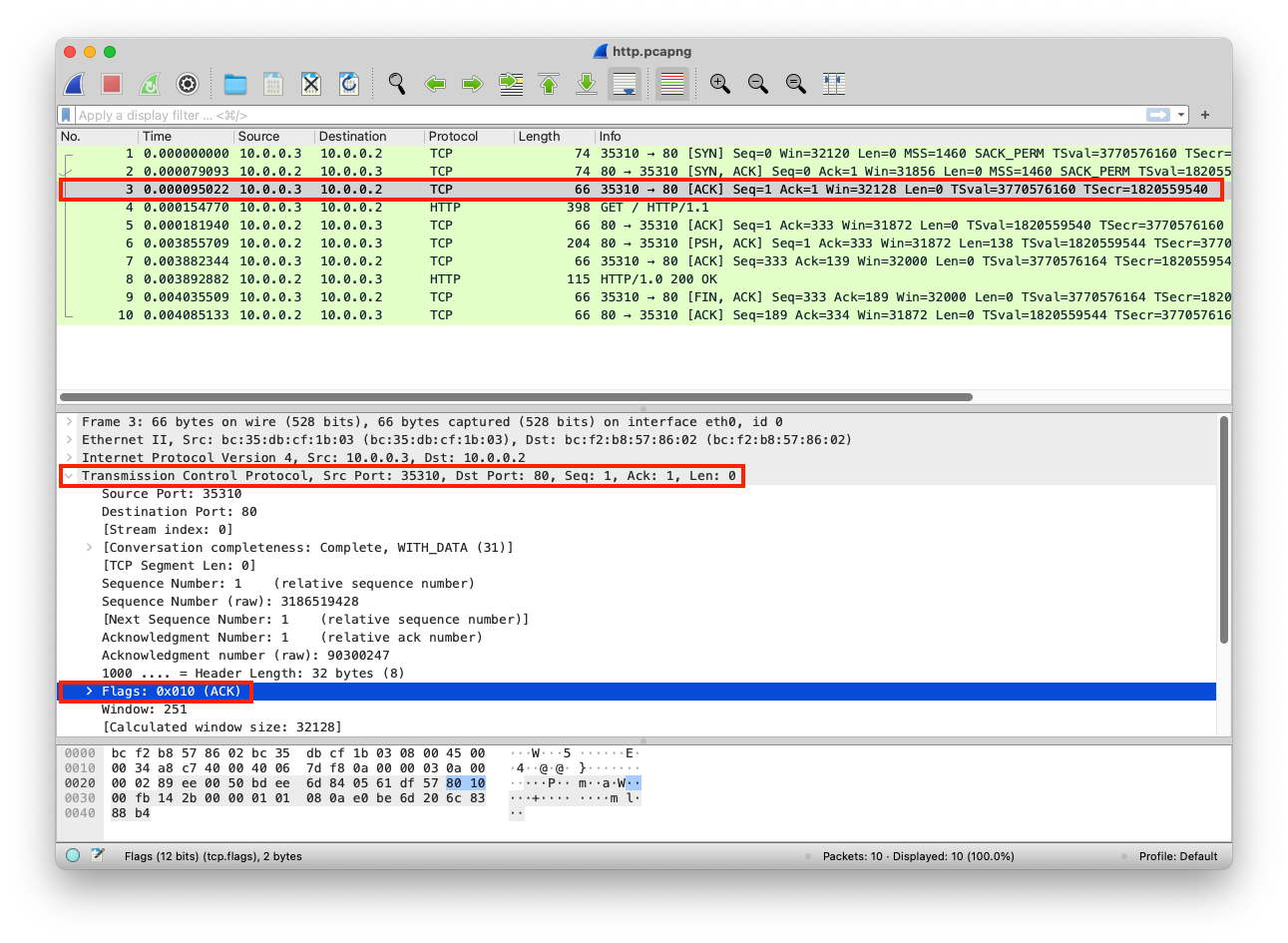
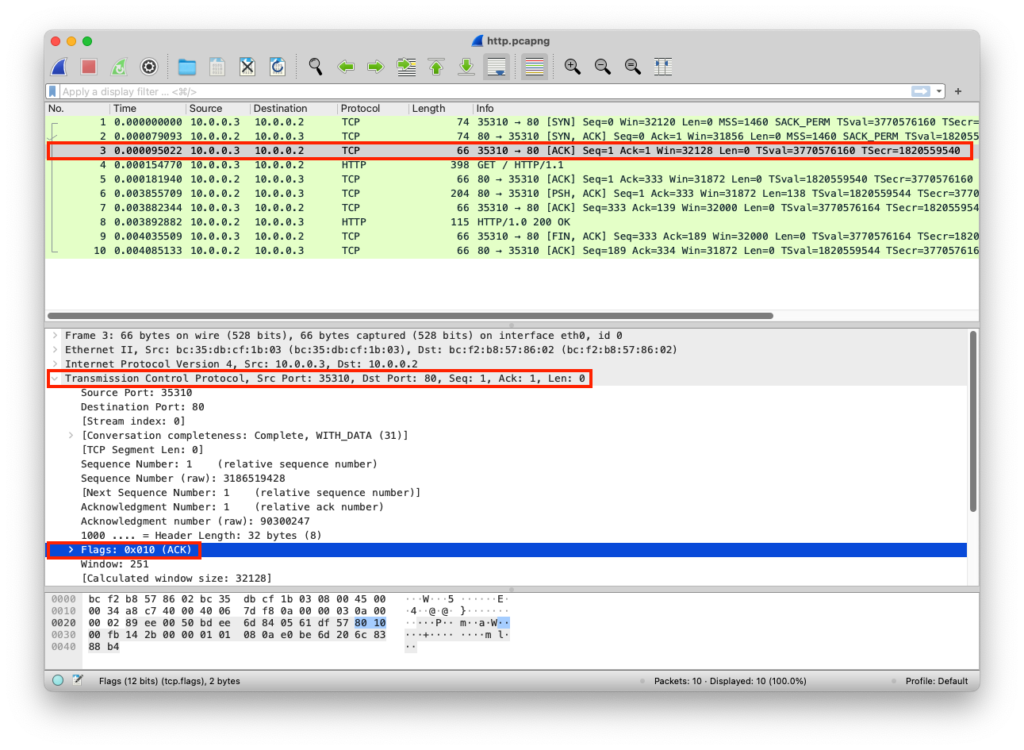
    Transmission Control Protocol (TCP) is a connection-oriented protocol that ensures reliable data transmission between processes on different devices over a network. Before any data transfer occurs, TCP establishes a connection using a three-way handshake to synchronize both the sender and receiver and ensure they are ready to communicate.

    Once the connection is established, TCP divides the data into segments for transmission. It verifies delivery by receiving acknowledgments from the receiving device. If any segment is lost or corrupted during transmission, TCP automatically retransmits it to ensure complete and accurate data delivery.

    This reliability makes TCP ideal for applications where data integrity and order are critical, such as web browsing, email, and file transfers.

    • Pros
      • Reliable
      • Error checking and recovery
    • Cons
      • Slow
      • Resource intensive
    • Uses
      • File sharing
      • Downloading
    • Flags
      • SYN: Starts a connection (It’s set at the beginning of TCP connection)
      • ACK: Confirms that data or initiation request has been received
      • RST: Aborts the connection immediately
      • FIN: Aborts the connection gracefully
      • PSH: Pushes the data to the application as soon as possible (No intermediate buffering)
      • URG: Prioritizes the data (This flag is obsolete)

    User Datagram Protocol (UDP)

    User Datagram Protocol (UDP) is a connectionless, message-oriented protocol that allows processes to send data over a network without establishing a prior connection or verifying delivery. Unlike TCP, UDP does not provide mechanisms for sequencing, acknowledgment, or retransmission. This means data packets may arrive out of order, be duplicated, or even be lost without notice.

    This lightweight approach reduces overhead and latency, making UDP ideal for applications that require fast, real-time communication. Such applications include video streaming, online gaming, voice over IP (VoIP), and broadcasting, where speed and efficiency are prioritized over guaranteed delivery.

    • Pros
      • Fast
      • Simple
    • Cons
      • Does not have any error recovery
    • Uses
      • Video streaming
      • Real-time services
    • Flags
      • None

    *Note, UDP does have error checking but doesn’t have any error-recovery


    Logical Ports

    Logical ports are virtual connection points within an operating system that facilitate the sending and receiving of data over a network. Each port is identified by a 16-bit number ranging from 0 to 65,535, allowing multiple services to operate simultaneously on the same device without conflict.

    Ports numbered below 1024 are known as privileged or well-known ports. Running services on these ports typically requires elevated system privileges, such as administrative rights, to ensure the security and proper management of critical services like web, email, or FTP servers.

    The assignment and use of these ports can vary slightly depending on the operating system. Still, in all cases, logical ports provide a structured way to direct network traffic to the correct application or process.

    Common Used Ports

    • File Transfer Protocol (ftp/21)
    • Secure Shell Protocol (ssh/22)
    • Teletype Network (telnet/23)
    • Simple Mail Transfer Protocol (SMTP/25)
    • Domain Name System Protocol (DNS/53)
    • Hypertext Transfer Protocol (http/80)
    • Hypertext Transfer Protocol Secure (https/443)
    • Microsoft Directory Services (microsoft-ds/445)
    • Remote Desktop Protocol (ms-wbt-server/3389
    • Viewer Remote Desktop (vnc/5900)

    Enumerate Ports (Locally)

    Enumerating ports locally involves identifying which ports are currently in use by services and applications on a computer. This can be done using commands such as netstat or lsof, which display all active and listening ports along with the associated processes.

    By running these commands, administrators can monitor network activity, troubleshoot connectivity issues, and verify that services are operating on the intended ports. For example, if you run a custom web server, you might observe it actively listening on port 80, the standard port for HTTP traffic, confirming that the service is properly bound and ready to receive incoming connections.

    This local enumeration is essential for network management, security auditing, and ensuring proper service configuration.

    lsof -i -P -n | grep -E "(LISTEN)"
    Python    1544   www    3u  IPv4 0x0      0t0  TCP *:80 (LISTEN)

    Enumerate Ports (Remote host)

    Enumerating ports on a remote host involves discovering which network services are reachable from outside the target and identifying the ports they listen on. Common techniques include TCP and UDP scanning (e.g., SYN/half-open or full-connect scans), service and version detection (banner grabbing), and targeted probes to identify specific application behavior. These tasks are often performed using tools like Nmap or Masscan for legitimate inventorying and threat hunting.

    This activity, described in the MITRE ATT&CK® Reconnaissance matrix as Network Service Discovery, helps defenders build asset inventories and prioritize patching, while attackers use the same information to plan exploitation. The results typically inform follow-up actions such as vulnerability assessment or access control changes.


    PCAP Example

    The web server is listening on port 80. The client can connect to this web server using the network adapter IP, but they do not need to specify port 80 in the web browser because it uses the HTTP protocol. If the web server port is 6789, the client can do http://<Network_Adapter_IP>:6789

    from http.server import SimpleHTTPRequestHandler # Import the built-in HTTP request handler
    from socketserver import TCPServer # Import a basic TCP server implementation
    from io import BytesIO # Import BytesIO to handle bytes in memory (for gzip compression)
    from gzip import GzipFile # Import GzipFile to compress HTTP response 
    from datetime import datetime # Import datetime to generate timestamps for logging
    from contextlib import suppress # Import suppress to prevent crashes

    with suppress(Exception): # Try importing network interface details
        from netifaces import gateways, ifaddresses, AF_INET, AF_LINK # Network interface utilities
        print(“The default network interface is: “, gateways()[‘default’][AF_INET][1]) # Display default network interface name
        print(“The default network interface mac address is: “, ifaddresses(gateways()[‘default’][AF_INET][1])[AF_LINK]) # Display MAC address of the default network interface

    class Server(SimpleHTTPRequestHandler): # Define a custom HTTP server

        def do_GET(self): # Handle HTTP GET requests
            compressed = False # Track whether gzip compression is used
            content = b'<HTML><h1>Hello World!</h1></HTML>’ # HTTP response body (bytes)

            if len(content) > 0: # Only attempt compression if content exists
                if ‘accept-encoding’ in self.headers: # Check if client sent Accept-Encoding header
                    if ‘gzip’ in self.headers[‘accept-encoding’]: # Client supports gzip
                        bytes_ = BytesIO() # Create an in-memory byte buffer
                        with GzipFile(fileobj=bytes_, mode=’w’, compresslevel=5) as f: # Gzip wrapper
                            f.write(content) # Compress the response body
                        content = bytes_.getvalue() # Replace content with compressed bytes
                        compressed = True # Mark response as compressed

            self.send_response(200) # Send HTTP 200 OK status
            if compressed:
                self.send_header(‘content-encoding’, ‘gzip’) # Notify client of gzip encoding
            self.send_header(‘content-length’, len(content)) # Send content length header
            self.end_headers() # End HTTP headers
            self.wfile.write(content) # Write response body to client

        def log_message(self, format, *args): # Override default request logging
            print(“[{}] – {}:{} – {} {}”.format( # Custom log format
                datetime.now().strftime(“%m/%d/%Y %H:%M:%S”), # Timestamp
                self.client_address[0], # Client IP address
                self.client_address[1], # Client source port
                args[0], # HTTP method
                args[1] # Requested path
            ))

    TCPServer((‘0.0.0.0’, 80), Server).serve_forever() # Start server on all interfaces, port 80

    from http.server import SimpleHTTPRequestHandler
    from socketserver import TCPServer
    from io import BytesIO
    from gzip import GzipFile
    from datetime import datetime
    from contextlib import suppress

    with suppress(Exception):
        from netifaces import gateways, ifaddresses, AF_INET, AF_LINK
        print("The default network interface is: ",gateways()['default'][AF_INET][1])
        print("The default network interface mac address is: ",ifaddresses(gateways()['default'][AF_INET][1])[AF_LINK])

    class Server(SimpleHTTPRequestHandler):
        def do_GET(self):
            compressed = False
            content = b'<HTML><h1>Hello World!</h1></HTML>'
            if len(content) > 0:
                if 'accept-encoding' in self.headers:
                    if 'gzip' in self.headers['accept-encoding']:
                        bytes_ = BytesIO()
                        with GzipFile(fileobj=bytes_, mode='w', compresslevel=5) as f:
                            f.write(content)
                            f.close()
                            content = bytes_.getvalue()
                            compressed = True
            self.send_response(200)
            if compressed:
                self.send_header('content-encoding', 'gzip')
            self.send_header('content-length', len(content))
            self.end_headers()
            self.wfile.write(content)

        def log_message(self, format, *args):
            print("[{}] - {}:{} - {} {}".format(datetime.now().strftime("%m/%d/%Y %H:%M:%S"), self.client_address[0],self.client_address[1],args[0],args[1]))

    TCPServer(('0.0.0.0', 80), Server).serve_forever()

    Client initiates 3-way handshake

    The client sends Synchronize Sequence Number (SYN) request

    LayerProtocolPDUInfoPortsIPsMACs
    Transport LayerTCPSegments3 Way handshake Process (SYN)Src Port: 35310
    Dst Port: 80
    Network LayerIPPackets3 Way handshake Process (SYN)Src Port: 35310
    Dst Port: 80
    Src IP: 10.0.0.3
    Dst IP: 10.0.0.2
    Data Link LayerEthernetFrames3 Way handshake Process (SYN)Src Port: 35310
    Dst Port: 80
    Src IP: 10.0.0.3
    Dst IP: 10.0.0.2
    Src MAC: bc:35:db:cf:1b:03
    Dst MAC: bc:f2:b8:57:86:02
    Physical LayerCoaxBits01001000 01010100 0101010001001000 0101010001001000 0101010001001000 01010100

    The server receives the SYN request

    LayerProtocolPDUInfoPortsIPsMACs
    Physical LayerCoaxBits01001000 01010100 0101010001001000 0101010001001000 0101010001001000 01010100
    Data Link LayerEthernetFrames3-Way handshake Process (SYN)Src Port: 35310
    Dst Port: 80
    Src IP: 10.0.0.3
    Dst IP: 10.0.0.2
    Src MAC: bc:35:db:cf:1b:03
    Dst MAC: bc:f2:b8:57:86:02
    Network LayerIPPackets3-Way handshake Process (SYN)Src Port: 35310
    Dst Port: 80
    Src IP: 10.0.0.3
    Dst IP: 10.0.0.2
    Transport LayerTCPSegments3-Way handshake Process (SYN)Src Port: 35310
    Dst Port: 80

    The server responds with Acknowledgement Sequence Number (SYN/ACK)

    LayerProtocolPDUInfoPortsIPsMACs
    Transport LayerTCPSegments3-Way handshake Process (SYN/ACK)Src Port: 80
    Dst Port: 35310
    Network LayerIPPackets3-Way handshake Process (SYN/ACK)Src Port: 80
    Dst Port: 35310
    Src IP: 10.0.0.2
    Dst IP: 10.0.0.3
    Data Link LayerEthernetFrames3-Way handshake Process (SYN/ACK)Src Port: 80
    Dst Port: 35310
    Src IP: 10.0.0.2
    Dst IP: 10.0.0.3
    Src MAC: bc:f2:b8:57:86:02
    Dst MAC: bc:35:db:cf:1b:03
    Physical LayerCoaxBits01001000 01010100 0101010101001000 0101010001001000 0101010001001000 01010100

    The client receives the SYN/ACK request

    LayerProtocolPDUInfoPortsIPsMACs
    Physical LayerCoaxBits01001000 01010100 0101010101001000 0101010001001000 0101010001001000 01010100
    Data Link LayerEthernetFrames3-Way handshake Process (SYN/ACK)Src Port: 80
    Dst Port: 35310
    Src IP: 10.0.0.2
    Dst IP: 10.0.0.3
    Src MAC: bc:f2:b8:57:86:02
    Dst MAC: bc:35:db:cf:1b:03
    Network LayerIPPackets3-Way handshake Process (SYN/ACK)Src Port: 80
    Dst Port: 35310
    Src IP: 10.0.0.2
    Dst IP: 10.0.0.3
    Transport LayerTCPSegments3-Way handshake Process (SYN/ACK)Src Port: 80
    Dst Port: 35310

    The client sends the ACK 

    LayerProtocolPDUInfoPortsIPsMACs
    Transport LayerTCPSegments3-Way handshake Process (ACK)Src Port: 35310
    Dst Port: 80
    Network LayerIPPackets3-Way handshake Process (ACK)Src Port: 35310
    Dst Port: 80
    Src IP: 10.0.0.3
    Dst IP: 10.0.0.2
    Data Link LayerEthernetFrames3-Way handshake Process (ACK)Src Port: 35310
    Dst Port: 80
    Src IP: 10.0.0.3
    Dst IP: 10.0.0.2
    Src MAC: bc:35:db:cf:1b:03
    Dst MAC: bc:f2:b8:57:86:02
    Physical LayerCoaxBits01001000 01010100 0101011101001000 0101010001001000 0101010001001000 01010100

    The server receives ACK request

    LayerProtocolPDUInfoPortsIPsMACs
    Physical LayerCoaxBits01001000 01010100 0101011101001000 0101010001001000 0101010001001000 01010100
    Data Link LayerEthernetFrames3-Way handshake Process (SYN/ACK)Src Port: 35310
    Dst Port: 80
    Src IP: 10.0.0.3
    Dst IP: 10.0.0.2
    Src MAC: bc:35:db:cf:1b:03
    Dst MAC: bc:f2:b8:57:86:02
    Network LayerIPPackets3-Way handshake Process (SYN/ACK)Src Port: 35310
    Dst Port: 80
    Src IP: 10.0.0.3
    Dst IP: 10.0.0.2
    Transport LayerTCPSegments3-Way handshake Process (SYN/ACK)Src Port: 35310
    Dst Port: 80
  • Network Layer

    Network Layer

    Network Layer

    The Network Layer is the third layer in the OSI (Open Systems Interconnection) model, responsible for enabling communication between devices on different networks. Unlike the Data Link Layer, which handles data transfer within a local network, the Network Layer ensures that data can travel across multiple interconnected networks to reach its intended destination.
    It abstracts the physical and logical complexities of underlying networks, enabling devices to communicate even when separated by routers or switches. The layer packages data into units called packets and adds logical addressing information (typically IP) to facilitate accurate delivery.

    One primary function is routing, which determines the most efficient path for data from the source to the destination across one or more networks. Routers operate at this layer, examining destination IP addresses and using routing tables and protocols like OSPF or BGP to forward packets.

    The Network Layer also handles fragmentation, breaking down large packets into smaller ones when required by the network’s maximum transmission unit (MTU), and reassembling them at the receiving end to ensure data integrity.

    Additionally, the Network Layer plays a crucial role in error handling, congestion control, and logical addressing. It provides unique IP addresses to devices and manages packet traversal across networks, enabling efficient and reliable operation of complex topologies. The layer supports important network services, such as Quality of Service (QoS), which prioritizes certain types of traffic, and security features, such as IP filtering and access control.

    Overall, the Network Layer forms the backbone of internetwork communication, ensuring seamless data movement between devices regardless of their physical or geographical location.


    Internet Protocol (IP)

    The Internet Protocol (IP) is a fundamental set of rules that govern how data is addressed, routed, and transmitted across interconnected networks, enabling communication and information exchange over the internet. IP assigns unique logical addresses, known as IP addresses, to devices, allowing each device to be identified and located within a network.

    When data is sent, it is broken into packets, each containing source and destination IP addresses. These addresses guide packets through multiple networks and intermediate devices, such as routers, to reach their intended destinations. IP defines how packets are formatted, addressed, and handled during transmission, ensuring reliable traversal of complex network paths.

    By providing a standardized method for addressing and routing, IP forms the backbone of internet communication and underpins virtually all modern networking protocols and services.


    Internet Protocol Address V4 (IPv4)

    IPv4 is a network address used to identify and locate devices on a network uniquely. It uses a 32-bit addressing system, allowing approximately 4.3 billion unique addresses. These addresses are typically represented in dotted-decimal notation, consisting of four octets separated by periods (e.g., 192.168.1.1).

    IPv4 addresses are essential for routing data packets between different devices and networks, ensuring that information is delivered to the correct destination.

    Binary

    A numbering scheme that expressed in the base-2 numeral system (0 or 1)

    11000000.10101000.00000001.00000001

    Decimal

    A numbering scheme that expressed in the base-10 system (0, 1, 2, 3, 4, 5, 6, 7, 8, 9)

    192.168.1.1


    IPv4 Addresses Classification

    • Public addresses
      • Used for external communication (access the Internet)
    • Private addresses
      • Used for internal communication (access resources in a local network)

    IPv4 Addresses Classes

    • Class A
      • 1.0.0.1 to 126.255.255.254
      • Networks: 126
      • Host per 1 a networks: 16,777,214
      • Subnet Mask: 255.0.0.0
      • Private Range
        • 10.0.0.0 to 10.255.255.255
      • Used for very large networks
    • Class B
      • 128.1.0.1 to 191.255.255.254
      • Networks: 16,382
      • Host per 1 a networks: 65,534
      • Subnet Mask: 255.255.0.0
      • Private Range
        • 172.16.0.0 to 172.31.255.255
        • 169.254.0.0 to 169.254.255.255
          • Automatic Private IP Addressing (APIPA)
          • A device will assign itself an IP address within that range if Dynamic Host Configuration Protocol (DHCP) does not work or failed
      • Used for small networks
    • Class C
      • 192.0.1.1 to 223.255.254.254
      • Networks: 2,097,150
      • Host per 1 a networks: 254
      • Subnet Mask: 255.255.255.0
      • Private Range
        • 192.168.0.0 to 192.168.255.255
      • Used for very small-sized network
    • Class D
      • 224.0.0.0 to 239.255.255.255
      • Reserved for multicast groups.
    • Class E
      • 240.0.0.0 to 254.255.255.254
      • Research/Reserved/Experimental

    Note: Class A also has 127.0.0.0 to 127.255.255.255 are reserved for loopback and diagnostic (Those addresses cannot be used)


    Subnet 

    A subnet, or subnetwork, divides a larger network into smaller, more manageable segments to improve performance, security, and organization. Each subnet is a distinct logical network with its own range of IP addresses, allowing devices within the subnet to communicate efficiently while controlling traffic flow between different subnets.

    Subnetting reduces network congestion by limiting broadcast traffic to each segment, making it easier for administrators to implement policies, manage resources, and isolate issues. It also enhances security by segmenting sensitive areas, controlling access, and minimizing exposure of critical devices to the entire network. Overall, subnets provide flexibility and scalability, enabling large networks to function smoothly while maintaining structure and control.

    • 255.0.0.0 – /8 – 1 network – 16,777,214 hosts in the network
    • 255.128.0.0 – /9 – 2 subnets – 8,388,606 hosts in each network
    • 255.192.0.0 – /10 –  4 subnets – 4,194,302 hosts in each network
    • 255.224.0.0 – /11 –  8 subnets – 2,097,150 hosts in each network
    • 255.240.0.0 – /12 –  16 subnets – 1,048,574 hosts in each network
    • 255.248.0.0 – /13 –  32 subnets – 524,286 hosts in each network
    • 255.252.0.0 – /14 –  64 subnets – 262,142 hosts in each network
    • 255.254.0.0 – /15 –  128 subnets – 131,070 hosts in each network
    • 255.255.0.0 – /16 –  256 subnets – 65,534 hosts in each network
    • 255.255.128.0 – /17 –  512 subnets – 32,766 hosts in each network
    • 255.255.192.0 – /18 –  1,024 subnets – 16,384 hosts in each network
    • 255.255.224.0 – /19 –  2,048 subnets – 8,190 hosts in each network
    • 255.255.240.0 – /20 –  4,096 subnets – 4,094 hosts in each network
    • 255.255.248.0 – /21 –  8,192 subnets – 2,046 hosts in each network
    • 255.255.252.0 – /22 –  16,384 subnets – 1,022 hosts in each network
    • 255.255.254.0 – /23 –  32,768 subnets – 510 hosts in each network
    • 255.255.255.0 – /24 –  65,536 subnets – 254 hosts in each network
    • 255.255.255.128 – /25 –  131,072 subnets – 126 hosts in each network
    • 255.255.255.192 – /26 –  262,144 subnets – 62 hosts in each network
    • 255.255.255.224 – /27 –  524,288 subnets – 30 hosts in each network
    • 255.255.255.240 – /28 –  1,048,576 subnets – 14 hosts in each network
    • 255.255.255.248 – /29 –  2,097,152 subnets – 6 hosts in each network
    • 255.255.255.252 – /30 –  4,194,304 subnets – 2 hosts in each network

    Internet Protocol Address V4 (IPv4) Example

    192.168.1.0/25, the first node starts at 0, and the last one is 126

    • 192.168.1.0
      • 0 is the network address (network identifier)
    • 192.168.1.2
      • A node on the network
    • 192.168.1.126
      • Last node on the network
    • 192.168.1.127
      • Broadcast address (All nodes in that subnet respond to it)

    Router

    A router is a physical or virtual networking device that connects multiple computer networks and forwards data packets between them. Operating at the Network Layer of the OSI model, routers use IP addresses to determine the best path for each packet to reach its destination. They maintain a routing table containing information about network paths and routes, enabling them to make intelligent forwarding decisions based on factors such as network topology, congestion, and cost.

    Routers enable communication between different networks, such as connecting a home network to the internet. They also provide important services, such as network traffic management, segmentation, and security, through features like firewalls and access control lists. By directing data efficiently and ensuring it reaches the correct destination, routers are a critical component of modern network infrastructure.


    VLAN Interconnection

    VLAN interconnection is a networking technique that enables communication and routing between multiple Virtual Local Area Networks (VLANs) that are otherwise logically isolated from each other. While VLANs segment a physical network into separate virtual networks to improve security, reduce broadcast traffic, and organize devices, devices on different VLANs cannot communicate directly without a method for interconnection.

    This is achieved through routing, either with a Layer 3 switch that supports inter-VLAN routing or a router configured to handle traffic between VLANs. VLAN interconnection allows organizations to maintain the benefits of network segmentation while enabling controlled data exchange between departments, services, or applications. This ensures both efficiency and security in complex network environments.


    VLAN Interconnection (Router on stick – Trunk port)

    VLAN interconnection using the “Router on a Stick” method is a networking technique that allows routing between multiple VLANs through a single physical router interface. In this setup, a trunk port on the router carries traffic for all VLANs. Each packet is tagged to indicate its VLAN membership using a protocol such as IEEE 802.1Q.

    The router inspects the VLAN tag, determines the destination VLAN, and routes the traffic accordingly. This enables devices on different VLANs to communicate while maintaining logical segmentation. 

    This approach is cost-effective because it eliminates the need for multiple physical interfaces on the router, making it a popular solution in small-to medium-sized networks where efficient hardware use and simplified configuration are priorities.


    Cyberattacks

    • Man in the Middle (MITM)
      • A threat actor intercepts and relays messages between 2 targets
        • Eavesdropping attack – Evil Twin
        • Spoofing attack
          • ARP Spoofing
            • A threat utilizing the victim’s MAC – This happens after the ARP poising, and the threat actor can carry the end goal of the cyberattack like a man in the middle (T1557.002  Adversary-in-the-Middle: ARP Cache Poisoning)
          • DNS Spoofing
            • When a victim gets directed to a malicious website (This happens after DNS poising)

    PCAP Example

    The web server here uses 0.0.0.0 IP; this is a placeholder that means listen to all, it accepts incoming connections from all network adapters (If this was 127.0.0.1, it would only be accessible to processes running on the device itself). A client can connect to this web server using the network adapter IP, in this case, the network adapter IP is 10.0.0.2 as shown in the Wireshark image

    from http.server import SimpleHTTPRequestHandler # Import the built-in HTTP request handler
    from socketserver import TCPServer # Import a basic TCP server implementation
    from io import BytesIO # Import BytesIO to handle bytes in memory (for gzip compression)
    from gzip import GzipFile # Import GzipFile to compress HTTP response 
    from datetime import datetime # Import datetime to generate timestamps for logging
    from contextlib import suppress # Import suppress to prevent crashes

    with suppress(Exception): # Try importing network interface details
        from netifaces import gateways, ifaddresses, AF_INET, AF_LINK # Network interface utilities
        print(“The default network interface is: “, gateways()[‘default’][AF_INET][1]) # Display default network interface name
        print(“The default network interface mac address is: “, ifaddresses(gateways()[‘default’][AF_INET][1])[AF_LINK]) # Display MAC address of the default network interface

    class Server(SimpleHTTPRequestHandler): # Define a custom HTTP server

        def do_GET(self): # Handle HTTP GET requests
            compressed = False # Track whether gzip compression is used
            content = b'<HTML><h1>Hello World!</h1></HTML>’ # HTTP response body (bytes)

            if len(content) > 0: # Only attempt compression if content exists
                if ‘accept-encoding’ in self.headers: # Check if client sent Accept-Encoding header
                    if ‘gzip’ in self.headers[‘accept-encoding’]: # Client supports gzip
                        bytes_ = BytesIO() # Create an in-memory byte buffer
                        with GzipFile(fileobj=bytes_, mode=’w’, compresslevel=5) as f: # Gzip wrapper
                            f.write(content) # Compress the response body
                        content = bytes_.getvalue() # Replace content with compressed bytes
                        compressed = True # Mark response as compressed

            self.send_response(200) # Send HTTP 200 OK status
            if compressed:
                self.send_header(‘content-encoding’, ‘gzip’) # Notify client of gzip encoding
            self.send_header(‘content-length’, len(content)) # Send content length header
            self.end_headers() # End HTTP headers
            self.wfile.write(content) # Write response body to client

        def log_message(self, format, *args): # Override default request logging
            print(“[{}] – {}:{} – {} {}”.format( # Custom log format
                datetime.now().strftime(“%m/%d/%Y %H:%M:%S”), # Timestamp
                self.client_address[0], # Client IP address
                self.client_address[1], # Client source port
                args[0], # HTTP method
                args[1] # Requested path
            ))

    TCPServer((‘0.0.0.0’, 80), Server).serve_forever() # Start server on all interfaces, port 80

    from http.server import SimpleHTTPRequestHandler
    from socketserver import TCPServer
    from io import BytesIO
    from gzip import GzipFile
    from datetime import datetime
    from contextlib import suppress

    with suppress(Exception):
        from netifaces import gateways, ifaddresses, AF_INET, AF_LINK
        print("The default network interface is: ",gateways()['default'][AF_INET][1])
        print("The default network interface mac address is: ",ifaddresses(gateways()['default'][AF_INET][1])[AF_LINK])

    class Server(SimpleHTTPRequestHandler):
        def do_GET(self):
            compressed = False
            content = b'<HTML><h1>Hello World!</h1></HTML>'
            if len(content) > 0:
                if 'accept-encoding' in self.headers:
                    if 'gzip' in self.headers['accept-encoding']:
                        bytes_ = BytesIO()
                        with GzipFile(fileobj=bytes_, mode='w', compresslevel=5) as f:
                            f.write(content)
                            f.close()
                            content = bytes_.getvalue()
                            compressed = True
            self.send_response(200)
            if compressed:
                self.send_header('content-encoding', 'gzip')
            self.send_header('content-length', len(content))
            self.end_headers()
            self.wfile.write(content)

        def log_message(self, format, *args):
            print("[{}] - {}:{} - {} {}".format(datetime.now().strftime("%m/%d/%Y %H:%M:%S"), self.client_address[0],self.client_address[1],args[0],args[1]))

    TCPServer(('0.0.0.0', 80), Server).serve_forever()

    Clint/Server IP Addresses

    The IPs are added to each packet

    LayerProtocolPDUInfoPortsIPsMACs
    Transport LayerTCPSegments3 Way handshake Process (SYN)Src Port: 35310
    Dst Port: 80
    Network LayerIPPackets3 Way handshake Process (SYN)Src Port: 35310
    Dst Port: 80
    Src IP: 10.0.0.3
    Dst IP: 10.0.0.2
    Data Link LayerEthernetFrames3 Way handshake Process (SYN)Src Port: 35310
    Dst Port: 80
    Src IP: 10.0.0.3
    Dst IP: 10.0.0.2
    Src MAC: bc:35:db:cf:1b:03
    Dst MAC: bc:f2:b8:57:86:02
    Physical LayerCoaxBits01001000 01010100 0101010001001000 0101010001001000 0101010001001000 01010100
  • Data Link Layer

    Data Link Layer

    Data Link

    The Data Link Layer is the second layer in the OSI model. It enables reliable data transmission between two directly connected devices on the same network. This layer takes the raw bit-stream from the Physical Layer and organizes it into structured units called frames. These frames include not only the data being sent but also important control information, such as source and destination addresses, error-detection codes, and sequencing details. This ensures that data is properly packaged for accurate delivery and helps detect or correct transmission errors.

    In addition to framing, the Data Link Layer manages data flow to prevent network congestion and collisions, especially in shared networks. It uses protocols such as Ethernet for wired networks and Wi-Fi for wireless networks to control access to the medium, coordinate transmissions, and ensure that only one device transmits at a time. The layer also checks for errors using mechanisms such as cyclic redundancy checks (CRC), allowing the receiving device to identify corrupted frames and request retransmission if needed.

    The Data Link Layer is divided into two sublayers: the Logical Link Control (LLC) sublayer, which handles communication between higher layers and provides error and flow control; and the Media Access Control (MAC) sublayer, which manages how devices on the same network segment access the shared medium. Together, these functions ensure reliable and efficient communication between nodes on the same network, serving as a critical bridge between the raw transmission capabilities of the Physical Layer and the logical communication handled by higher layers, such as the Network Layer.


    Ethernet Protocol

    A set of rules governing the communication and exchange of data between two nodes on the same network

    • Framing: a technique that divides a data stream into smaller parts
    • Physical addressing: a technique that adds (encapsulates) the source and destination’s MAC address to each frame
    • Error control: a technique that detects and corrects the error (If possible)
    • Flow controls: a technique that synchronizes the receiving and sending speed between nodes
    • Access control: a technique that allows multiple devices to use the same communication channel

    Two sub-layers

    • Logical Link Control
      • Multiplexing
        • A technique that combines multiple data streams over a single medium
      • De-multiplexing
        • A technique that reverts one input data signal back to multiple data streams
      • Flow control
        • A technique that manages how much data it can transmit between the sender and receiver
      • Error detection
        • A technique that checks whether the receiver has received correct data or not
    • Media Access Control and its primary purpose is framing

    Bridge

    A bridge is a networking device that connects and filters traffic between two separate network segments, usually with two ports. It operates at the Data Link Layer of the OSI model and uses MAC (Media Access Control) addresses to make forwarding decisions.

    When a data packet arrives at a port, the bridge examines the destination MAC address to determine whether to forward it to the other port or keep it within the same segment. This helps reduce unnecessary traffic. Bridges maintain a MAC address table, also known as a forwarding table, which maps devices to their respective ports. This enables efficient, intelligent traffic management.

    By segmenting networks and controlling data flow, bridges improve overall network performance, reduce collisions, and better organize network resources.


    L2 Switch

    A Layer 2 (L2) switch is a network device that connects multiple devices within the same local area network (LAN). It operates at the Data Link Layer of the OSI model. Unlike a bridge, which typically has only two ports, an L2 switch has multiple ports, allowing it to handle traffic between many devices simultaneously.

    An L2 switch uses MAC (Media Access Control) addresses to determine the destination of incoming data packets and stores this information in a MAC address table (or lookup table). This allows the switch to forward packets only to the appropriate port, reducing unnecessary network congestion and collisions. By intelligently directing traffic, an L2 switch improves overall network efficiency and provides a scalable way to expand a LAN while maintaining high-speed and reliable communication between connected devices.


    Physical Segmentation

    Physical segmentation involves dividing a network into separate subnets using hardware devices like switches, routers, or bridges. This approach physically isolates different parts of the network, improving traffic management, enhancing security, and reducing congestion and collisions within each subnet.

    By creating distinct segments, network administrators can control data flow more effectively, implement specific policies for each segment, and limit the impact of network failures or security breaches to only the affected area. Physical segmentation is commonly used in enterprise networks, data centers, and environments where performance and security are critical, as it provides a clear and effective way to organize and optimize network infrastructure.


    Logical Segmentation

    Logical segmentation is the process of dividing a network into separate subnets or virtual networks using software-based configurations rather than physical hardware. This is typically achieved through technologies such as VLANs (Virtual Local Area Networks) and subnetting, which allow devices on the same physical network to be grouped into isolated logical networks.

    Logical segmentation improves network management by enabling administrators to control traffic flow, apply security policies, and optimize performance without reconfiguring or adding new hardware. It also enhances scalability and flexibility, allowing networks to adapt to changing organizational needs and support multiple departments or applications. By containing broadcast traffic within each logical subnet, logical segmentation reduces congestion and improves overall network efficiency.


    Media Access Control Address (MAC Address)

    A Media Access Control (MAC) address is a unique 12-digit hexadecimal identifier assigned to a network interface card (NIC) or other network hardware. It serves as a physical address that identifies a device on a local network. The MAC address is hardcoded by the manufacturer and used by network devices, such as switches and bridges, to ensure the accurate delivery of data frames within the network.

    The first half of the MAC address typically identifies the manufacturer, allowing for vendor identification, while the second half is a unique identifier for the specific device. MAC addresses are essential for network communication, traffic management, and security functions, including device authentication and network access control. They play a foundational role in both wired and wireless networking environments.

    Examples

    • 00:11:22:AA:CC:DD
    • 0011.22AA.CCDD
    • 00-11-22-AA-CC-DD

    Cyberattacks

    • ARP Poisoning
      • A cyberattack where a threat actor sends malicious ARP over a local area network (LAN) to link a threat actor’s MAC address with a legitimate device IP on the network (In case of man in the middle, the packet is sent to the default gateway and the victim) (T1557 Adversary-in-the-Middle: ARP Cache Poisoning)
    • Spanning Tree Attack
      • A threat actor plugs a rouge L2 switch and manipulates other devices’ priority value; all traffic goes to the threat actor device ()
    • VLAN Hopping
      • Switch Spoofing
        • A threat actor plugs a rouge L2 switch to a mis-configured network, the rouge L2 switch forms an unauthorized trunk connection and gains access to the VLAN
      • Double Tagging
        • A threat actor modifies the Ethernet frames tags, which allows packets to be sent through any VLAN
    • DHCP Snooping

    PCAP Example

    The python web server uses the default network interface that has a specific MAC address

    from http.server import SimpleHTTPRequestHandler # Import the built-in HTTP request handler
    from socketserver import TCPServer # Import a basic TCP server implementation
    from io import BytesIO # Import BytesIO to handle bytes in memory (for gzip compression)
    from gzip import GzipFile # Import GzipFile to compress HTTP response 
    from datetime import datetime # Import datetime to generate timestamps for logging
    from contextlib import suppress # Import suppress to prevent crashes

    with suppress(Exception): # Try importing network interface details
        from netifaces import gateways, ifaddresses, AF_INET, AF_LINK # Network interface utilities
        print(“The default network interface is: “, gateways()[‘default’][AF_INET][1]) # Display default network interface name
        print(“The default network interface mac address is: “, ifaddresses(gateways()[‘default’][AF_INET][1])[AF_LINK]) # Display MAC address of the default network interface

    class Server(SimpleHTTPRequestHandler): # Define a custom HTTP server

        def do_GET(self): # Handle HTTP GET requests
            compressed = False # Track whether gzip compression is used
            content = b'<HTML><h1>Hello World!</h1></HTML>’ # HTTP response body (bytes)

            if len(content) > 0: # Only attempt compression if content exists
                if ‘accept-encoding’ in self.headers: # Check if client sent Accept-Encoding header
                    if ‘gzip’ in self.headers[‘accept-encoding’]: # Client supports gzip
                        bytes_ = BytesIO() # Create an in-memory byte buffer
                        with GzipFile(fileobj=bytes_, mode=’w’, compresslevel=5) as f: # Gzip wrapper
                            f.write(content) # Compress the response body
                        content = bytes_.getvalue() # Replace content with compressed bytes
                        compressed = True # Mark response as compressed

            self.send_response(200) # Send HTTP 200 OK status
            if compressed:
                self.send_header(‘content-encoding’, ‘gzip’) # Notify client of gzip encoding
            self.send_header(‘content-length’, len(content)) # Send content length header
            self.end_headers() # End HTTP headers
            self.wfile.write(content) # Write response body to client

        def log_message(self, format, *args): # Override default request logging
            print(“[{}] – {}:{} – {} {}”.format( # Custom log format
                datetime.now().strftime(“%m/%d/%Y %H:%M:%S”), # Timestamp
                self.client_address[0], # Client IP address
                self.client_address[1], # Client source port
                args[0], # HTTP method
                args[1] # Requested path
            ))

    TCPServer((‘0.0.0.0’, 80), Server).serve_forever() # Start server on all interfaces, port 80

    from http.server import SimpleHTTPRequestHandler
    from socketserver import TCPServer
    from io import BytesIO
    from gzip import GzipFile
    from datetime import datetime
    from contextlib import suppress

    with suppress(Exception):
        from netifaces import gateways, ifaddresses, AF_INET, AF_LINK
        print("The default network interface is: ",gateways()['default'][AF_INET][1])
        print("The default network interface mac address is: ",ifaddresses(gateways()['default'][AF_INET][1])[AF_LINK])

    class Server(SimpleHTTPRequestHandler):
        def do_GET(self):
            compressed = False
            content = b'<HTML><h1>Hello World!</h1></HTML>'
            if len(content) > 0:
                if 'accept-encoding' in self.headers:
                    if 'gzip' in self.headers['accept-encoding']:
                        bytes_ = BytesIO()
                        with GzipFile(fileobj=bytes_, mode='w', compresslevel=5) as f:
                            f.write(content)
                            f.close()
                            content = bytes_.getvalue()
                            compressed = True
            self.send_response(200)
            if compressed:
                self.send_header('content-encoding', 'gzip')
            self.send_header('content-length', len(content))
            self.end_headers()
            self.wfile.write(content)

        def log_message(self, format, *args):
            print("[{}] - {}:{} - {} {}".format(datetime.now().strftime("%m/%d/%Y %H:%M:%S"), self.client_address[0],self.client_address[1],args[0],args[1]))

    TCPServer(('0.0.0.0', 80), Server).serve_forever()

    Clint/Server IP Addresses

    The MACs are added to each packet

    LayerProtocolPDUInfoPortsIPsMACs
    Transport LayerTCPSegments3 Way handshake Process (SYN)Src Port: 35310
    Dst Port: 80
    Network LayerIPPackets3 Way handshake Process (SYN)Src Port: 35310
    Dst Port: 80
    Src IP: 10.0.0.3
    Dst IP: 10.0.0.2
    Data Link LayerEthernetFrames3 Way handshake Process (SYN)Src Port: 35310
    Dst Port: 80
    Src IP: 10.0.0.3
    Dst IP: 10.0.0.2
    Src MAC: bc:35:db:cf:1b:03
    Dst MAC: bc:f2:b8:57:86:02
    Physical LayerCoaxBits01001000 01010100 0101010001001000 0101010001001000 0101010001001000 01010100
  • Physical Layer

    Physical Layer

    Physical Layer

    The Physical Layer is the lowest layer in the OSI (Open Systems Interconnection) model, defining physical connections between devices in a network. It handles raw binary data, or bit-streams, consisting of 1s and 0s without processing or decision-making.

    This layer converts bits into signals for transmission over media such as copper cables, fiber-optic networks, or wireless networks. In electrical cables, bit representation is 1 for medium-high voltage and 0 for low voltage; in optical fibers, it is 1 for light pulses and 0 for their absence.

    The Physical Layer also defines connector types, cable specifications, signal frequencies, transmission rates (bandwidth), and network topology. It ensures reliable data transmission between devices, forming the foundation for higher layers of the network model. Though it is unaware of the content being transmitted, its proper functioning is critical for overall performance and reliability.


    Coaxial Cable

    A coaxial cable is an electrical cable designed to transmit radio frequency (RF) signals with minimal loss and interference. It consists of a central copper conductor surrounded by an insulating layer, a metallic shield, and an outer protective jacket. The metallic shield protects the signal from electromagnetic interference, making coaxial cables ideal for applications like cable television, internet connections, and radio communications.

    Coaxial cables can transmit high-frequency signals over long distances while maintaining signal integrity, and they are widely used in both residential and commercial networking environments.


    Binary

    Binary is a base-2 number system using only two values: 1 and 0. It represents all forms of data and instructions in digital systems. Each digit in a binary number, called a bit, is the fundamental unit of information in computing and digital communications.

    The simplicity of binary makes it ideal for electronic devices, as circuits can easily distinguish between two states-ON (1) and OFF (0), or high and low voltage. By combining multiple bits, complex data, instructions, and multimedia content can be efficiently encoded, stored, and transmitted, forming the foundation of modern computing and digital communication technologies.

    echo -n "qeeqbox" | xxd -b
    00000000: 01110001 01100101 01100101 01110001 01100010 01101111  qeeqbo
    00000006: 01111000                                               x

    Bits

    A bit, short for binary digit, is the smallest unit of data in a computer and represents a single binary value: 0 or 1. Bits are the fundamental building blocks of all digital information, forming the basis for how computers store, process, and transmit data. By combining multiple bits, more complex units such as bytes, characters, and instructions can be represented.

    Despite their simplicity, bits enable computers to perform a wide range of operations, from basic calculations to running sophisticated software, making them essential to the functioning of all digital systems.

    1  On
    0 Off

    Bytes

    A byte is a unit of digital information consisting of 8 bits and is commonly used to represent a single character, such as a letter, number, or symbol. For example, the letter "C" is represented in binary as 01000011, with each bit contributing to the character’s value.

    While one byte is sufficient for most standard ASCII characters, more complex characters (such as those from non-Latin alphabets, emojis, or special symbols) may require multiple bytes, as seen in encoding schemes like UTF-8. Bytes serve as a fundamental unit of memory and storage in computers, allowing data to be organized, processed, and transmitted efficiently across digital systems.

    00110001 is equal to 1
    01110100 01100101 01110011 01110100 is equal to test

    Medium types

    • Cables
      • The signals are electrical pulses
    • Fiber
      • The signals are light pluses
    • Wireless
      • The signals are electromagnetic waves

    Some Functions

    • Transmission mode
      • Simplex: A unidirectional communication where the sender sends data, and the receiver receives data 
      • Half duplex: A bidirectional communication where the sender can send or receive data but only in one direction at a time
      • Full duplex: A bidirectional communication simultaneously where the sender can send and receive data at a time
    • Physical typologies
      • Point-to-point: Two nodes are connected with a dedicated link
      • Bus: Nodes are connected using a single cable
      • Ring: Each node is connected (Point-to-point) to another on each side, the last one is connected to the first one (Data travels in a circle)
      • Mesh: Nodes are connected (Point-to-point) with all the other nodes
      • Star: Nodes are connected to a central node (Each node communicates indirectly through the central node)

    Latency

    Latency is the time it takes for data to travel from its source to its destination across a network or system. It is a critical measure of network performance and responsiveness, influenced by factors such as physical distance, the quality of the transmission medium, the number of network hops, and processing time at intermediate devices.

    Low latency is essential for real-time applications such as video conferencing, online gaming, and financial trading, where even small delays can significantly degrade performance and user experience. High latency can cause lag, slow data transfers, and reduced efficiency, making it a key consideration in network design, optimization, and


    Wired vs. Wireless

    • Wired
      • Faster data transfer: Speed is consistent
      • Has Lower latency: Data travels faster, which means low latency by default
      • Hard to deploy: Connected devices usually do not move (Desktop)
      • More secure (Data does not need to be encrypted?): Data can be accessed by devices that physically attached to that network
    • Wireless
      • Slow data transfer
        • Speed is not consistent
      • Has higher latency
        • Distance
        • Data is susceptible to noise (Re-send)
        • Data is encrypted and needs some time to be decrypted
      • Easy to deploy
        • Connected devices can be moved (A smart phone)
      • Less secure (Data needs to be encrypted?)
        • Data travels through the air and can be intercepted

    Examples

    • Network interface cards (NIC): Provides a physical connection to a network
    • Modem: Converts the signal type from one type to another type
    • Hubs: Connects multiple devices in the network (A node that broadcasts data to all connected devices)
    • Cables: A wire or a set of wires that connects one device with another

    Physical attacks


    PCAP Example

    In the PCAP file, you can get an overview of the data by clicking on the entry, then Frame 1 (In this case, it’s the metadata gathered about the data), which includes detailed info about the data that are transmitted or received, some of the info, like interface id, name, and description, are not part of the data, but they are in Wireshark for analysis and troubleshooting network problems

    from http.server import SimpleHTTPRequestHandler # Import the built-in HTTP request handler
    from socketserver import TCPServer # Import a basic TCP server implementation
    from io import BytesIO # Import BytesIO to handle bytes in memory (for gzip compression)
    from gzip import GzipFile # Import GzipFile to compress HTTP response 
    from datetime import datetime # Import datetime to generate timestamps for logging
    from contextlib import suppress # Import suppress to prevent crashes

    with suppress(Exception): # Try importing network interface details
        from netifaces import gateways, ifaddresses, AF_INET, AF_LINK # Network interface utilities
        print(“The default network interface is: “, gateways()[‘default’][AF_INET][1]) # Display default network interface name
        print(“The default network interface mac address is: “, ifaddresses(gateways()[‘default’][AF_INET][1])[AF_LINK]) # Display MAC address of the default network interface

    class Server(SimpleHTTPRequestHandler): # Define a custom HTTP server

        def do_GET(self): # Handle HTTP GET requests
            compressed = False # Track whether gzip compression is used
            content = b'<HTML><h1>Hello World!</h1></HTML>’ # HTTP response body (bytes)

            if len(content) > 0: # Only attempt compression if content exists
                if ‘accept-encoding’ in self.headers: # Check if client sent Accept-Encoding header
                    if ‘gzip’ in self.headers[‘accept-encoding’]: # Client supports gzip
                        bytes_ = BytesIO() # Create an in-memory byte buffer
                        with GzipFile(fileobj=bytes_, mode=’w’, compresslevel=5) as f: # Gzip wrapper
                            f.write(content) # Compress the response body
                        content = bytes_.getvalue() # Replace content with compressed bytes
                        compressed = True # Mark response as compressed

            self.send_response(200) # Send HTTP 200 OK status
            if compressed:
                self.send_header(‘content-encoding’, ‘gzip’) # Notify client of gzip encoding
            self.send_header(‘content-length’, len(content)) # Send content length header
            self.end_headers() # End HTTP headers
            self.wfile.write(content) # Write response body to client

        def log_message(self, format, *args): # Override default request logging
            print(“[{}] – {}:{} – {} {}”.format( # Custom log format
                datetime.now().strftime(“%m/%d/%Y %H:%M:%S”), # Timestamp
                self.client_address[0], # Client IP address
                self.client_address[1], # Client source port
                args[0], # HTTP method
                args[1] # Requested path
            ))

    TCPServer((‘0.0.0.0’, 80), Server).serve_forever() # Start server on all interfaces, port 80

    from http.server import SimpleHTTPRequestHandler
    from socketserver import TCPServer
    from io import BytesIO
    from gzip import GzipFile
    from datetime import datetime
    from contextlib import suppress

    with suppress(Exception):
        from netifaces import gateways, ifaddresses, AF_INET, AF_LINK
        print("The default network interface is: ",gateways()['default'][AF_INET][1])
        print("The default network interface mac address is: ",ifaddresses(gateways()['default'][AF_INET][1])[AF_LINK])

    class Server(SimpleHTTPRequestHandler):
        def do_GET(self):
            compressed = False
            content = b'<HTML><h1>Hello World!</h1></HTML>'
            if len(content) > 0:
                if 'accept-encoding' in self.headers:
                    if 'gzip' in self.headers['accept-encoding']:
                        bytes_ = BytesIO()
                        with GzipFile(fileobj=bytes_, mode='w', compresslevel=5) as f:
                            f.write(content)
                            f.close()
                            content = bytes_.getvalue()
                            compressed = True
            self.send_response(200)
            if compressed:
                self.send_header('content-encoding', 'gzip')
            self.send_header('content-length', len(content))
            self.end_headers()
            self.wfile.write(content)

        def log_message(self, format, *args):
            print("[{}] - {}:{} - {} {}".format(datetime.now().strftime("%m/%d/%Y %H:%M:%S"), self.client_address[0],self.client_address[1],args[0],args[1]))

    TCPServer(('0.0.0.0', 80), Server).serve_forever()

    Clint/Server Data

    The data is transmitted and transported in raw format

    LayerProtocolPDUInfoPortsIPsMACs
    Transport LayerTCPSegments3 Way handshake Process (SYN)Src Port: 35310
    Dst Port: 80
    Network LayerIPPackets3 Way handshake Process (SYN)Src Port: 35310
    Dst Port: 80
    Src IP: 10.0.0.3
    Dst IP: 10.0.0.2
    Data Link LayerEthernetFrames3 Way handshake Process (SYN)Src Port: 35310
    Dst Port: 80
    Src IP: 10.0.0.3
    Dst IP: 10.0.0.2
    Src MAC: bc:35:db:cf:1b:03
    Dst MAC: bc:f2:b8:57:86:02
    Physical LayerCoaxBits01001000 01010100 0101010001001000 0101010001001000 0101010001001000 01010100
    Physical Layer
  • OSI Model

    OSI Model

    Network

    A computer network connects devices like computers, servers, routers, and other hardware to share data, resources, and services. These networks create pathways for information to flow between devices, enabling activities such as sending emails, browsing the web, streaming video, or participating in video calls.

    Computer networks can vary in size and complexity. Local Area Networks (LANs) connect devices within small areas like homes, offices, or schools. Wide Area Networks (WANs) cover larger geographic regions, linking offices, data centers, or even countries. The internet is the largest global network, connecting billions of devices worldwide.

    Networks are essential for our daily digital lives, supporting personal communication, business operations, online education, healthcare systems, financial transactions, cloud computing, and many other services. They rely on protocols, hardware, and security measures to ensure data is transmitted efficiently, reliably, and safely between devices.


    Network Security

    Network security refers to methods, technologies, and procedures used to protect computer networks and their resources from unauthorized access, misuse, modification, or disruption. It ensures sensitive information (such as personal data, financial records, or confidential business information) remains safe while maintaining the availability and integrity of network services

    Network security covers a wide range of practices including:

    • Access Control: Restricting who can connect to the network or access specific resources using passwords, authentication systems, or multi-factor authentication (MFA).
    • Firewalls: Devices or software that monitor and filter incoming and outgoing traffic to block malicious activity.
    • Intrusion Detection and Prevention: Systems that detect unusual or suspicious activity and respond to potential threats.
    • Encryption: Protecting data in transit by converting it into a format unreadable by unauthorized users.
    • Network Monitoring: Continuously observing network traffic and performance to identify potential security breaches or vulnerabilities.
    • Regular Updates and Patching: Ensuring network devices and software are up to date to protect against known vulnerabilities.

    Effective network security not only prevents unauthorized access but also reduces the risk of data breaches, malware infections, and service disruptions, helping maintain trust, reliability, and operational continuity for individuals and organizations alike.


    Protocols

    In networking, a protocol is a formal set of rules and conventions that govern how devices communicate over a network. Protocols define data formatting, transmission, routing, and reception, ensuring information from one device can be correctly interpreted by another, even if they are from different manufacturers or run different software. They cover aspects like error detection, data compression, addressing, encryption, and session management, making communication reliable and secure.

    Examples of common network protocols include:

    • HTTP/HTTPS: For web traffic
    • FTP (File Transfer Protocol): Transfers files between a client and server
    • SSH (Secure Shell Protocol): Enables secure communication between two computers
    • Telnet: Enables communication between two computers
    • SMTP (Simple Mail Transfer Protocol): Sends, receives, and relays emails
    • DNS (Domain Name System): Translates human-readable hostnames into IP addresses
    • TCP/IP (Transmission Control Protocol/Internet Protocol): For end-to-end communication
    • IMAP (Internet Message Access Protocol): Retrieves messages from email servers
    • HTTPS: Securely transports data between a client and web server
    • Microsoft Directory Services (Microsoft-DS): Used for file sharing over TCP/IP by SMB service
    • MySQL: Relational database management system
    • RDP (Remote Desktop Protocol, ms-wbt-server): Interacts with a desktop computer remotely
    • VNC (Viewer Remote Desktop): Interacts with a desktop computer remotely

    By following standardized protocols, networks achieve interoperability, efficiency, and consistency, allowing diverse systems to work together seamlessly.


    Open Systems Interconnection (OSI)

    The Open Systems Interconnection (OSI) model is a standardized framework for understanding and implementing network communications. It consists of seven distinct layers, each defining specific functions and protocols to ensure successful data exchange between devices on a network. The layers, from bottom to top, are Physical, Data Link, Network, Transport, Session, Presentation, and Application.

    The OSI model provides a structured approach to designing and troubleshooting networks by clearly separating different network functions, such as how data is physically transmitted, how devices are addressed and routed, how data integrity is ensured, and how applications access network services. Introduced in the 1980s based on ISO recommendations, the OSI model serves as a universal reference that promotes interoperability between hardware and software from different vendors, making it easier to design, manage, and maintain complex network systems.

    Layers

    Layer 7ApplicationHTTP, HTTPS, FTP, SMTPHost Layer
    Layer 6PresentationASCII, JPEG, GZIPHost Layer
    Layer 5SessionSocketHost Layer
    Layer 4TransportTCP, UDPHost Layer
    Layer 3NetworkIPv4, IPv6, IPSecMedia Layer
    Layer 2Data LinkPPP, IEEE, L2TP, EthernetMedia Layer
    Layer 1PhysicalCables, WirelessMedia Layer

    OSI in Action – Browsing The Internet (Web Client)

    Layer 7ApplicationHTTPthe client uses a web browser to send http data
    Layer 6PresentationGZIPhandles the data format and compresses it (If applicable)
    Layer 5SessionSocketopens a session for communication between source and destination (Web Server)
    Layer 4TransportTCPdata is segmented, and each segment will have the source and destination port number
    Layer 3NetworkIPv4converts segments into packets; each packet will have the source and destination IP address
    Layer 2Data LinkEthernetconverts packets into frames; each frame will have the source and destination MAC address
    Layer 1PhysicalCoaxconverts frames into bit-stream and send the data over the physical medium

    OSI in Action – Browsing The Internet (Web Server)

    Layer 1PhysicalCoaxconverts bit-stream into frames
    Layer 2Data LinkEthernetmerges all frames into packets
    Layer 3NetworkIPv4converts packets into segments
    Layer 4TransportTCPconverts segments into data
    Layer 5SessionSocketdata is kept
    Layer 6PresentationGZIPdecompresses data and reverts the formatting
    Layer 7ApplicationHTTPthe destination receives the client http data

    Python Web Server

    Python has a built-in package called http.server that can be used as file server or a customized web server that handles HTTP(s) requests.

    How to Run http.server (Default)

    In the terminal, go to the directory that has the static content (files, images, etc..) and type python3 -m http.server, this serves the directory content to clients (Some threat actors utilize this method when they breach a network, Python is most likely running on the devices, so it’s used to move data in the breached network). After running the http.server it will show if it was successful or not, and the port that’s used

    python3 # Python using version 3
    -m # Tell Python to run a module as a script
    http.server # Start the built-in HTTP file server on port 8000 (default)

    (RPi) python3 -m http.server
    Serving HTTP on :: port 8000 (http://[::]:8000/) 

    The output will change depending on the directory (folder) from which the server is started

    <html>
    <head>
    <meta http-equiv="Content-Type" content="text/html; charset=utf-8">
    <title>Directory listing for /</title>
    </head>
    <body>
    <h1>Directory listing for /</h1>
    <hr>
    <ul>
    <li><a href=".bash_history">.bash_history</a></li>

    How to Run http.server (Customized)

    The course content is built around a customized webserver that responds to HTTP GET requests, handles sessions/compressions, and logs requests. You may need to install a package called netifaces using pip3 install netifaces (In case you do not want to run the server or having issues with it, there is a Wireshark dump that was captured while interacting with the customized webserver, skip these steps)

    pip3 # The Python 3 package installer (runs pip for Python 3.x)
    install # The command telling pip3 to install a package
    netifaces # The name of the package to install, provides access to network interface information (IP, MAC addresses)

    (RPi) pip3 install netifaces

    Then copy the following into a file (E.g. server.py)

    from http.server import SimpleHTTPRequestHandler # Import the built-in HTTP request handler
    from socketserver import TCPServer # Import a basic TCP server implementation
    from io import BytesIO # Import BytesIO to handle bytes in memory (for gzip compression)
    from gzip import GzipFile # Import GzipFile to compress HTTP response 
    from datetime import datetime # Import datetime to generate timestamps for logging
    from contextlib import suppress # Import suppress to prevent crashes

    with suppress(Exception): # Try importing network interface details
        from netifaces import gateways, ifaddresses, AF_INET, AF_LINK # Network interface utilities
        print(“The default network interface is: “, gateways()[‘default’][AF_INET][1]) # Display default network interface name
        print(“The default network interface mac address is: “, ifaddresses(gateways()[‘default’][AF_INET][1])[AF_LINK]) # Display MAC address of the default network interface

    class Server(SimpleHTTPRequestHandler): # Define a custom HTTP server

        def do_GET(self): # Handle HTTP GET requests
            compressed = False # Track whether gzip compression is used
            content = b'<HTML><h1>Hello World!</h1></HTML>’ # HTTP response body (bytes)

            if len(content) > 0: # Only attempt compression if content exists
                if ‘accept-encoding’ in self.headers: # Check if client sent Accept-Encoding header
                    if ‘gzip’ in self.headers[‘accept-encoding’]: # Client supports gzip
                        bytes_ = BytesIO() # Create an in-memory byte buffer
                        with GzipFile(fileobj=bytes_, mode=’w’, compresslevel=5) as f: # Gzip wrapper
                            f.write(content) # Compress the response body
                        content = bytes_.getvalue() # Replace content with compressed bytes
                        compressed = True # Mark response as compressed

            self.send_response(200) # Send HTTP 200 OK status
            if compressed:
                self.send_header(‘content-encoding’, ‘gzip’) # Notify client of gzip encoding
            self.send_header(‘content-length’, len(content)) # Send content length header
            self.end_headers() # End HTTP headers
            self.wfile.write(content) # Write response body to client

        def log_message(self, format, *args): # Override default request logging
            print(“[{}] – {}:{} – {} {}”.format( # Custom log format
                datetime.now().strftime(“%m/%d/%Y %H:%M:%S”), # Timestamp
                self.client_address[0], # Client IP address
                self.client_address[1], # Client source port
                args[0], # HTTP method
                args[1] # Requested path
            ))

    TCPServer((‘0.0.0.0’, 80), Server).serve_forever() # Start server on all interfaces, port 80

    from http.server import SimpleHTTPRequestHandler
    from socketserver import TCPServer
    from io import BytesIO
    from gzip import GzipFile
    from datetime import datetime
    from contextlib import suppress

    with suppress(Exception):
        from netifaces import gateways, ifaddresses, AF_INET, AF_LINK
        print("The default network interface is: ",gateways()['default'][AF_INET][1])
        print("The default network interface mac address is: ",ifaddresses(gateways()['default'][AF_INET][1])[AF_LINK])

    class Server(SimpleHTTPRequestHandler):
        def do_GET(self):
            compressed = False
            content = b'<HTML><h1>Hello World!</h1></HTML>'
            if len(content) > 0:
                if 'accept-encoding' in self.headers:
                    if 'gzip' in self.headers['accept-encoding']:
                        bytes_ = BytesIO()
                        with GzipFile(fileobj=bytes_, mode='w', compresslevel=5) as f:
                            f.write(content)
                            f.close()
                            content = bytes_.getvalue()
                            compressed = True
            self.send_response(200)
            if compressed:
                self.send_header('content-encoding', 'gzip')
            self.send_header('content-length', len(content))
            self.end_headers()
            self.wfile.write(content)

        def log_message(self, format, *args):
            print("[{}] - {}:{} - {} {}".format(datetime.now().strftime("%m/%d/%Y %H:%M:%S"), self.client_address[0],self.client_address[1],args[0],args[1]))

    TCPServer(('0.0.0.0', 80), Server).serve_forever()

    Then run the file as Python script with elevated privileges, the reason why you need to elevate privileges because the customized webserver is using port 80 (Port below 1024 can be open only with elevated privileges, E.g. root)

    sudo # Run the command with superuser (root) privileges
    python3 # Run the Python 3 interpreter
    server.py # The Python script file to execute (in this case, your HTTP server)

    (RPi) sudo python3 server.py
    The default network interface is:  eth0
    The default network interface mac address is:  [{'addr': 'bc:f2:b8:57:86:02'}]

    You can either use a web browser or client to communicate with that server, the content URL in this case is http://127.0.0.1:80

    curl # A command-line tool used to send requests and receive responses
    http://127.0.0.1:80  # Send an HTTP GET request to the local Python http.server running on port 80

    (RPi) curl http://127.0.0.1:80

    <HTML><h1>Hello World!</h1></HTML>

    Packet Analyzer (Wireshark)

    A tool or device for capturing and analyzing packets of data traveling in a communication channel. Click on open a capture file, then open the following http.pcapng file

    There are four important sections in Wireshark

    1. Filter Bar – You can filter the traffic based on specific rules like IP, port, or protocol
    2. Packets List – This shows the traffic as entries and you click on any of the entries for more details, or you can sort them by time, IP, etc..
    3. Packet Details – When you click on an entry, the details of that entry will show up in this section
    4. Packet bytes – You can review any packet bytes in this section, if you click on any byte, it will show the meaning of it in the Packet Details section (This is a very helpful feature)